Modern Car Technology Explained.
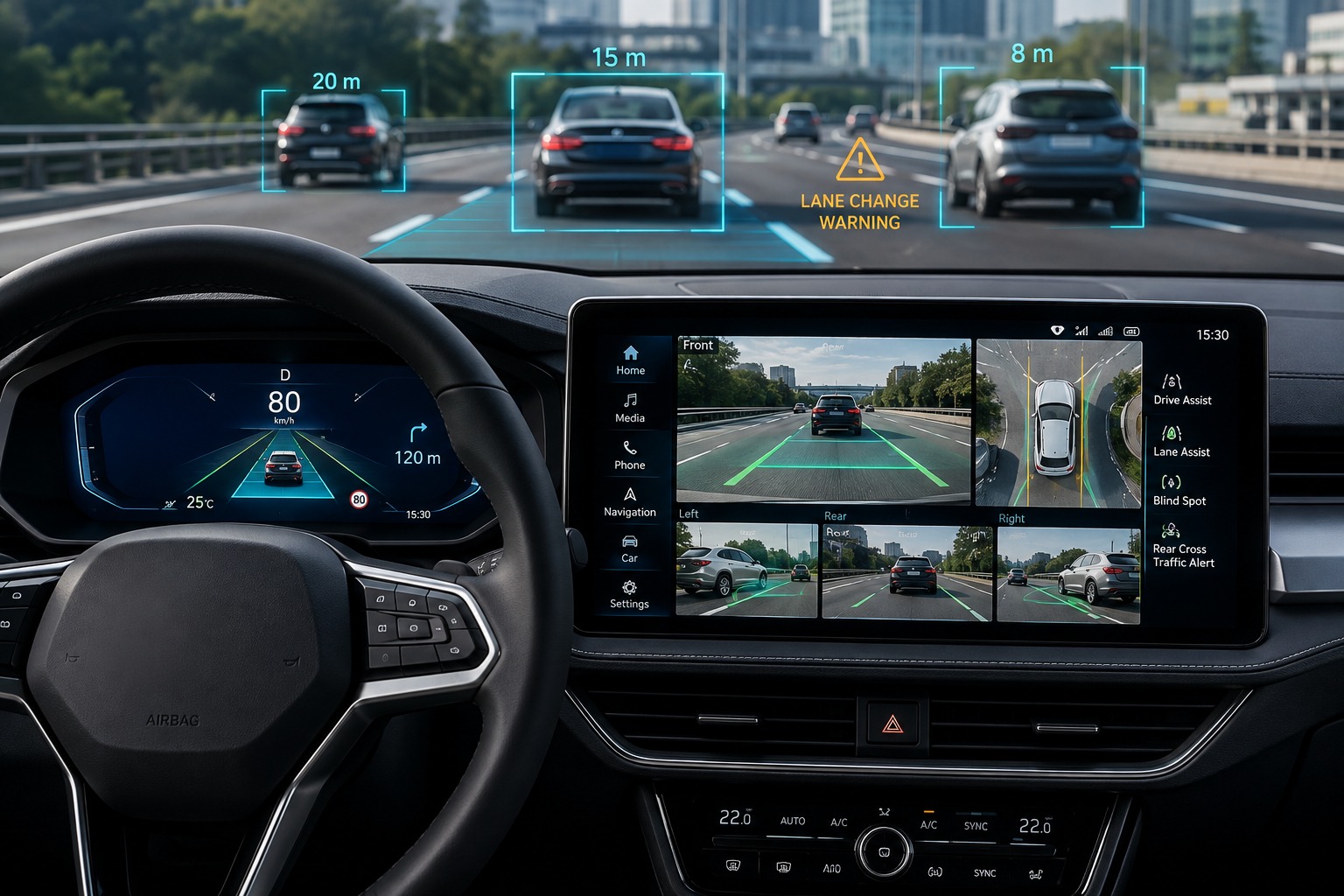
A modern car is no longer just an engine, a gearbox, a steering wheel and four wheels. Today's vehicles can carry dozens of computers, cameras, radar sensors, electric motors and software systems working together. But there is an important trap hidden inside all of that innovation: manufacturers use impressive marketing names for these technologies, and two cars can both advertise “autonomous driving” while offering very different capabilities. This guide takes modern car technology explained the way an expert would explain it to a first-time buyer — by focusing on what each technology actually does, rather than the name printed in the brochure.
First, Understand the Difference Between “Safety Technology” and “Autonomous Driving”
Before looking at individual features, it helps to think of driver-assistance technologies in three broad categories. In Category A, the car simply warns you — it sees something dangerous and tells you, as with Blind-Spot Warning. In Category B, the car actively helps you — it may steer, brake or accelerate on your behalf, but you remain responsible for driving, as with Lane-Keeping Assist combined with Adaptive Cruise Control. In Category C, the car can take over more of the driving task under specific, defined conditions, as with Mercedes-Benz DRIVE PILOT, a certified Level 3 system.
This distinction matters enormously. A car advertised as having “self-driving technology” does not necessarily mean you can sit in the back seat and let the car drive you to work. Tesla, for example, explicitly states that its current Full Self-Driving (Supervised) system does not make the vehicle autonomous and requires active driver supervision at all times. Mercedes' DRIVE PILOT is different: it is a certified Level 3 system, but it only operates under defined conditions and on approved roads. That framework — warns you, helps you, or can take over under specific conditions — is worth applying to every technology described below.
Lane and Steering Assistance
Lane Departure Warning (LDW)
Imagine driving on a highway, becoming tired, and starting to drift out of your lane. The car detects the lane markings and gives you a warning — it might vibrate the steering wheel, make a sound, display a warning, or show an alert on the dashboard. Crucially, the car may only warn you; it doesn't necessarily steer the vehicle back on its own. This matters because humans get distracted — looking at a child in the back, adjusting the radio, becoming tired, checking a phone, or being distracted by traffic — and the system provides another layer of protection against exactly those moments.
Lane-Keeping Assist (LKA)
This goes one step further. Instead of merely saying “you're leaving your lane,” the car can apply steering assistance to move the vehicle back toward the centre of the lane if it begins drifting toward the edge. It is particularly useful on highways, though it doesn't mean the car can drive itself — you still need to steer and monitor the road. The Jetour G700, for instance, lists both Lane-Keeping Assist and Lane Centering Keeping on certain trims.
Lane Centering
This is more advanced still. Think of your lane as a corridor: basic lane keeping tries to stop you crossing the walls, while lane centering tries to keep you approximately in the middle of that corridor at all times, continuously making small steering adjustments as you drift slightly left or right. The result is that the vehicle remains approximately centred, and this is one of the technologies that makes highway driving noticeably less tiring.
Speed and Distance Management
Adaptive Cruise Control (ACC)
Traditional cruise control simply holds a set speed — for example 100 km/h — and will keep trying to reach that speed even if traffic ahead slows to 70 km/h, unless you intervene. Adaptive Cruise Control is different: it uses radar and/or cameras to detect the vehicle ahead, so you might set a maximum speed of 100 km/h and a following distance of 3 seconds, and if traffic slows to 70 km/h your car slows with it, then accelerates again toward your selected speed once traffic clears. This is extremely useful on highways.
Full-Speed Adaptive Cruise Control
This is even more useful in stop-and-go traffic. A capable system can slow the vehicle all the way to a stop and then resume when traffic moves again — imagine traffic cycling through 60 km/h, 30 km/h, 10 km/h, a full stop, 15 km/h and back up to 40 km/h; a full-speed ACC system continuously manages the acceleration and braking within its operating limits. Some systems combine this with steering assistance, which leads to something more advanced still.
Traffic Jam Assist (TJA)
Traffic Jam Assist combines several technologies at once: maintaining your speed, maintaining following distance, braking, accelerating, keeping the vehicle in its lane, and centring it within that lane. Instead of you constantly cycling through brake, accelerate, steer, brake, steer, accelerate, the car helps with much of that repetitive work. The Jetour G700's specifications list Traffic Jam Assist, Full-Speed Adaptive Cruise Control and Lane Centering Keeping on specified trims. But it is worth remembering that Traffic Jam Assist is assistance, not permission to stop paying attention.
Collision Avoidance and Awareness
Automatic Emergency Braking (AEB)
This is one of the technologies worth prioritising for almost every buyer. Imagine driving at 50 km/h when a vehicle ahead suddenly stops and you don't react quickly enough — the car detects the potential collision and can warn you, prepare the braking system, apply the brakes, and potentially reduce the severity of the collision or avoid it altogether. It may also work with pedestrians and cyclists depending on the system. The Jetour G700 lists Active Braking/AEB on specified trims, and it is genuinely worth ranking AEB far above something like a giant entertainment screen when prioritising features.
Forward Collision Warning (FCW)
AEB and Forward Collision Warning are related but different. Forward Collision Warning essentially says “you are getting dangerously close to the vehicle or object ahead” — it warns you, while AEB can go further and actually brake if necessary. In short: FCW is the warning, and AEB is the intervention.
Blind-Spot Monitoring and Blind-Spot Intervention
When changing lanes, there is sometimes a vehicle you simply cannot see in your normal mirrors — your blind spot. A blind-spot monitoring system detects that vehicle, usually showing a small light in the side mirror, and if you activate your turn signal while another vehicle is in the blind spot, the system may give an additional warning. Some vehicles go further with Blind-Spot Intervention: if you start moving into another vehicle, the car may provide steering or braking assistance to discourage the lane change, which is considerably more advanced than a simple warning.
Rear Cross-Traffic Alert
Imagine reversing out of a parking space where you cannot see because another vehicle is parked next to you, while a car travels across the rear of your vehicle out of view. Rear Cross-Traffic Alert can detect the approaching vehicle and warn you, which is particularly useful in shopping centres, supermarkets, busy parking areas, and narrow parking spaces.
Door Opening Warning
This is a surprisingly useful modern feature. Imagine you've parked on the roadside and open your door just as a motorcycle approaches from behind — the car can detect the approaching traffic and warn you before you open the door into its path. Some vehicles call this Door Open Warning or Safe Exit Warning, and the Jetour G700 specification lists Door Opening Warning.
Sign Recognition and Speed Assistance
Traffic Sign Recognition
The car's camera can identify road signs — for example, spotting an 80 km/h sign and displaying “Speed limit 80 km/h” on the dashboard. Other systems can recognise stop signs, no-entry signs, overtaking restrictions and other regulatory signs, and some vehicles use this information to assist other driver-assistance systems.
Intelligent Speed Assistance
This builds on traffic-sign recognition: once the vehicle knows the detected speed limit is, say, 80 km/h, it can warn you if you're exceeding it, and some systems can also adjust the vehicle's speed depending on configuration. It is worth checking exactly what a particular car does here, because manufacturers implement this differently.
Cameras, Lighting, and Visibility
360-Degree Camera and Transparent Chassis
A 360-degree camera is one of the most useful features for a large SUV: instead of showing only the rear camera image, multiple cameras around the vehicle create a bird's-eye view, so you can essentially see the car from above. It helps when parking, reversing, driving through narrow spaces, avoiding pillars and walls, and parking close to another vehicle. The Jetour G700 lists a 360° camera along with a transparent-chassis function that sounds like science fiction but is actually a processed image, using cameras underneath and around the vehicle, that attempts to show what is beneath or immediately around the car — useful when driving over rocks, where you normally cannot see what's underneath the middle of the vehicle, and particularly valuable for off-road driving.
Auto High Beam and Matrix Headlights
Auto High Beam automatically switches between high and low beams depending on traffic and conditions — high beam when no vehicles are ahead, low beam when a vehicle approaches — reducing the chance of dazzling another driver. Adaptive or matrix headlights go further, selectively controlling portions of the headlight beam rather than switching the whole high beam on or off, so the system can keep the road illuminated while creating a darker section around an oncoming vehicle, improving night visibility without unnecessarily dazzling other road users. The G700's higher trims include matrix headlights and adaptive high beam.
Head-Up Display (HUD) and Digital Instrument Cluster
A Head-Up Display is one of the technologies worth experiencing personally before buying: instead of looking down at the dashboard for your speed, information such as your speed, navigation directions and the speed limit can appear projected in your field of vision, meaning your eyes spend less time moving away from the road. A digital instrument cluster, meanwhile, replaces traditional analogue gauges with a digital screen that can display speed, RPM, fuel, navigation, safety warnings, driver-assistance status and other vehicle information, with the main advantage being flexibility.
Night Vision
Some luxury vehicles use infrared cameras to detect objects or people that may be difficult to see with ordinary headlights, potentially highlighting pedestrians, animals and other hazards. This is more common in expensive luxury vehicles than ordinary cars, and it can be genuinely useful on poorly lit roads.
Parking Technology
Automatic Parking
Instead of manually calculating exactly when to turn the steering wheel, reverse, straighten and turn again while parallel parking, the car can detect a suitable parking space and control some or all of the steering — depending on the system, you may still control gear selection, braking and acceleration, while more advanced systems control much more, sometimes parking perpendicular or parallel automatically. Tesla, for example, offers Autopark on eligible vehicles.
Remote Parking
This is even more futuristic: on some systems, you can stand outside the vehicle and command it to move into or out of a parking space, useful if someone has parked too close to your driver's door. Tesla's current FSD (Supervised) package includes parking functions and vehicle summoning features on eligible vehicles.
Driver Monitoring
This is becoming increasingly important as driver-assistance systems become more capable. The vehicle can use a camera to monitor the driver's face and eyes and determine whether you are looking away, falling asleep, distracted, or not paying sufficient attention — this matters because if the car is helping you drive, the manufacturer needs a way to ensure you are still supervising it. Even without a camera, some cars can monitor driving behaviour more broadly through Driver Attention Warning: if the system detects signs of fatigue or unusual steering patterns, it may display a “take a break” message. It doesn't know exactly how tired you are — it is simply detecting patterns that may suggest reduced attention.
Suspension and Off-Road Technology
Adaptive Suspension and Air Suspension
Moving from driver assistance into mechanical technology, adaptive suspension can change how the vehicle behaves depending on the selected mode — Comfort mode softens the ride, Sport mode makes the vehicle firmer, and Off-Road mode raises or modifies the suspension depending on the vehicle, allowing one car to behave very differently in different situations. Air suspension takes this further, using air springs instead of relying solely on conventional steel springs so the vehicle can raise or lower itself — a high setting for rough or off-road terrain, a normal setting for everyday driving, and a low setting for highway driving or easier entry. This is one of the technologies that makes certain luxury SUVs extremely sophisticated, and the Jetour G700 is marketed with air suspension and magnetic ride control, along with adjustable ground clearance — for example moving from around 220 mm normally to 300+ mm off-road, depending on configuration — where higher settings improve ground clearance and obstacle clearance, and lower settings improve aerodynamics, entry ease and potentially high-speed stability.
The “Lifting a Wheel” Phenomenon, Explained
You may have seen videos of an advanced off-road vehicle apparently lifting a wheel off the ground, with people describing it simply as “the car can lift one tire.” But there are different technologies behind these demonstrations, and the important underlying concept is wheel control and torque distribution. Suppose you're driving over a large uneven obstacle and one wheel becomes lightly loaded or even loses contact with the ground — a conventional four-wheel-drive system can struggle because power may be wasted through the wheel with the least grip, while a sophisticated system can monitor individual wheel behaviour and electronically control where torque is delivered. The Jetour G700 uses dual electric motors, electric all-wheel drive and sophisticated electronic control, with features including X Mode, electronic virtual central locking, cross-axle/expert mode, and tank-turn capability. The important lesson: don't buy a car because you saw it lift a wheel in a video — ask what the technology actually does, because what matters for an off-road vehicle is whether it can maintain traction when the terrain becomes uneven.
Torque Vectoring, Tank Turn, and Crab Movement
Torque vectoring is one of the most important advanced driving technologies: instead of sending exactly the same driving force to every wheel, the vehicle can control torque distribution through a corner, determining that one wheel needs more power or that a slipping wheel needs its torque reduced, which improves cornering, traction, stability and off-road capability. The G700's dual-motor system provides very sophisticated control of front and rear electric drive as an example.
Tank Turn imitates the way a tank can rotate in place by moving its tracks in opposite directions — some advanced electric or all-wheel-drive vehicles can command their wheels to create a very tight turning movement, and Jetour lists Tank Turn as a feature on the G700, useful in very tight off-road environments though not something needed for the school run. Some advanced vehicles are also developing crab or sideways-movement systems that allow the vehicle to move diagonally or sideways depending on their steering and drivetrain architecture, which can help with tight parking, off-road positioning and narrow spaces, though this remains a specialised feature rather than something most buyers need.
Hill Descent Control and Hill Start Assist
Hill Descent Control automatically controls the vehicle's speed while driving down a very steep hill, crawling down the slope at a controlled speed instead of requiring you to constantly press the brake — particularly useful off-road, and listed as Hill Descent Assist on the Jetour G700. Hill Start Assist solves a different, simpler problem: when you stop on a hill and release the brake to accelerate, the vehicle can roll backwards slightly without assistance, so Hill Start Assist temporarily holds the brakes while you move your foot to the accelerator — a simple but very useful feature.
Core Stability and Braking Fundamentals
These are foundational safety systems worth understanding even though you may never consciously notice them working — which is actually a good thing, since safety systems often work silently in the background.
• Electronic Stability Control: if you turn sharply and the vehicle begins losing control, the system individually brakes wheels and reduces engine or motor power to help bring the vehicle back under control
• Traction Control: on mud, sand, wet grass or snow, if one wheel starts spinning, the system detects the wheelspin and reduces or redirects the available drive force to maintain traction
• Anti-lock Braking System (ABS): one of the most important technologies in modern cars — without it, slamming on the brakes can lock the wheels and dramatically reduce steering ability; ABS rapidly controls braking pressure so the wheels keep rotating enough for you to retain steering control, which is what you feel as pedal vibration during emergency braking
• Electronic Brakeforce Distribution: not all four wheels need exactly the same braking force, so the system distributes braking force according to conditions to improve braking stability
• Electronic Parking Brake: instead of pulling a traditional handbrake lever, you press a button and an electric mechanism applies the parking brake, with many modern vehicles also offering automatic parking-brake functions
Connectivity and Software
Digital Key and Remote Vehicle Control
Your smartphone can potentially become the car key, allowing you to unlock, lock, start the vehicle, and share access with another person, using technologies such as NFC or Bluetooth depending on the system. Beyond the key itself, modern connected cars can sometimes be controlled through a smartphone application to lock or unlock doors, check vehicle status, locate the vehicle, start climate control, monitor charging, and check fuel or battery levels — a feature set that is becoming increasingly common.
Over-the-Air (OTA) Updates
This is one of the biggest changes in modern vehicles. Traditionally, a software problem meant taking the car to the dealer; with OTA updates, the manufacturer releases a software update, the vehicle downloads it, and the software is updated remotely. Tesla is particularly well known for this approach, and its current vehicles receive software updates that can change or add functionality, meaning the car you buy today can potentially receive improvements later. The downside is that the vehicle becomes increasingly dependent on software.
AI Voice Assistants and Infotainment Screens
Modern cars increasingly allow you to speak naturally to the vehicle rather than pressing buttons — asking it to turn the temperature down, open the sunroof, find a restaurant or call your wife — and the Jetour G700, for example, lists an 8255 automotive processor with four-zone voice control. As for the large infotainment screen that controls navigation, music, phone, vehicle settings, cameras, climate and apps, it is worth remembering that a bigger screen does not automatically mean a better car; what matters more is whether it is fast, reliable, easy to use, responsive, clearly visible, and compatible with your phone.
Wireless CarPlay, Android Auto, and Wireless Charging
On compatible systems, your phone can connect to the vehicle without a cable, giving you access to maps, music, calls, messages and supported apps — for most buyers, this is more useful day-to-day than some of the flashier technology. Wireless phone charging lets you place a compatible phone on a charging pad without a cable, which is very convenient, though it is worth testing whether your particular phone fits the pad and whether it overheats.
Comfort and Convenience Features
• Ventilated seats: tiny fans circulate air through perforations in the seat, excellent in hot weather, especially with leather upholstery
• Heated seats: heating elements warm the seat, very useful in cold climates
• Massage seats: pneumatic or mechanical systems built into the seat provide massage functions — a luxury feature rather than a safety feature, worth ranking below AEB, blind-spot monitoring and good tyres in terms of priority
• Power seats with memory: save a preferred driving position for each driver, and press a button to move the seat back into that saved position — very useful when two people share the vehicle
• Panoramic sunroof: a large glass roof adds light and a more spacious feeling, but it's worth considering heat entering the cabin, roof shade quality, noise, long-term seal reliability and replacement cost rather than choosing it purely because it looks good in photographs
• Power tailgate: press a button, or on some advanced systems kick underneath the bumper, to open the boot — extremely useful when your hands are full of shopping
Electric Vehicle-Specific Technology
Vehicle-to-Load (V2L) and Vehicle-to-Home
This is particularly interesting on electric and plug-in hybrid vehicles: instead of only receiving electricity, the vehicle can provide it, effectively acting as a large portable battery capable of powering a laptop, fridge, lights, tools or camping equipment. The Jetour G700 lists 6.6 kW V2L power export, a genuinely useful feature for anyone who travels, camps, works remotely, or experiences power interruptions. Vehicle-to-Home takes the idea further, allowing a compatible vehicle to potentially provide electricity to a house — but this requires compatible hardware, electrical installation and regulatory support, and is not simply a matter of buying an EV and plugging it into the wall to power an entire house.
Regenerative Braking and One-Pedal Driving
In an electric or hybrid vehicle, braking can recover some of the vehicle's kinetic energy: instead of that energy simply becoming heat in the brake system, the electric motor acts as a generator and sends some energy back to the battery, which is one reason hybrids and EVs can be very efficient in stop-start driving. Some EVs extend this into one-pedal driving, where lifting your foot slows the car and pressing it accelerates the car — it takes some getting used to, but many EV drivers find it convenient once accustomed to it.
Battery Pre-Conditioning and Fast Charging
EVs can prepare the battery before fast charging by heating or cooling it to an appropriate temperature, which can improve charging performance — a feature worth looking for if you plan to do a lot of long-distance EV driving. Fast charging itself is not just about battery size; a car with a large battery isn't necessarily a fast-charging car, so it's worth considering maximum charging power, the charging curve, charger availability, battery temperature, and charging infrastructure. The Jetour G700 uses an 800V architecture with a global specification listing 170 kW fast charging, though market-specific specifications may differ, so it is always worth checking the exact vehicle being imported or sold.
The Big Question: What Does “Autopilot” Actually Mean?
This is where modern car technology explained badly can be most confusing, and where it is worth spending considerable time with a first-time buyer. There is an internationally recognised framework called the SAE driving automation levels, and it is worth understanding what each level actually means. At Level 0, you drive. At Level 1, the car helps with one driving function. At Level 2, the car can simultaneously assist with steering and speed or braking, but you remain responsible and must supervise. At Level 3, under defined conditions, the system can take responsibility for the driving task, but you must be able to take over when requested. At Level 4, the system can drive without you under specific operational conditions. At Level 5 — still a theoretical goal — the vehicle could drive anywhere a human could drive without human control.
Most consumer “self-driving” systems you will encounter today are not Level 5. Mercedes describes its ordinary driver-assistance packages as Level 2 and DRIVE PILOT as Level 3 under specific conditions, while Tesla's current FSD (Supervised) is also not autonomous — Tesla explicitly requires active driver supervision.
Tesla Autopilot and Full Self-Driving (Supervised)
Tesla's basic Autopilot uses driver-assistance functions such as traffic-aware cruise control and steering assistance. The more advanced Full Self-Driving (Supervised) system can perform functions such as lane changes, turns, roundabouts, intersections, highway entry and exit, navigation-based driving, and parking. But the crucial word remains Supervised — Tesla says the driver stays responsible and must remain attentive. So rather than saying “Tesla drives itself,” a more accurate description is that certain Tesla systems can perform a substantial amount of the driving under supervision, but the current system is not a fully autonomous vehicle.
Mercedes DRIVE PILOT
This is a different category altogether: Mercedes' DRIVE PILOT is a Level 3 conditional automated-driving system, meaning that under its approved operating conditions, the system can take over the driving task. Mercedes currently describes DRIVE PILOT as operating in specific conditions, including heavy traffic on predefined freeway networks and at speeds up to 40 mph in the U.S. implementation it describes. This is fundamentally different from a Level 2 system because of the driver's legal and operational role while the system is active — but it does not mean the Mercedes can drive anywhere without you. It cannot.
Jetour's Level 2 Assistance
Jetour's G700 specifications explicitly describe its higher trims as having L2-level autonomous driving assistance, with functions including adaptive cruise control, traffic-jam assist, lane keeping, lane centering, blind-zone detection and lane-change assistance. This is a good example of why it is worth looking beyond a phrase like “intelligent driving” and instead asking exactly what the system can do.
How to Test These Technologies Before Buying
Never let a salesperson simply read the specification sheet to you — ask for a demonstration instead, since this is the surest way to get modern car technology explained in practice rather than in marketing language. For a car you're seriously considering, it is worth testing each of the following:
• Emergency braking — ask how the system works and what objects it recognises
• Adaptive cruise — test it in normal traffic
• Lane keeping — see how it behaves around curves and imperfect lane markings
• Blind spot — test whether the warning is easy to see
• 360 camera — park between two vehicles
• Automatic parking — let the car find and park in a suitable space
• Driver monitoring — understand how it detects attention
• Night lighting — drive at night if possible
• Suspension — drive over rough roads and speed bumps
• Off-road systems — if you're buying something like a G700, test the actual off-road modes rather than just watching promotional videos
Read more on: Are Chinese Cars Reliable? The Honest, Evidence-Based Answer
The Features Worth Prioritizing for a Normal Family Buyer
With modern car technology explained tier by tier, it helps to rank the features roughly into four groups if you have a limited budget and are asking which technologies to pay for.
Essential
• Automatic Emergency Braking
• Forward Collision Warning
• Electronic Stability Control
• ABS
• Blind-Spot Monitoring
• Rear Cross-Traffic Alert
• Lane-Keeping Assistance
• Adaptive Cruise Control
• A good reversing camera
• Reliable parking sensors
Very Useful
• Lane Centering
• Traffic Jam Assist
• 360-degree camera
• Automatic high beam
• Adaptive/matrix headlights
• Driver monitoring
• Traffic-sign recognition
• Automatic parking
• Head-Up Display
• Rear-seat climate control
Excellent Luxury and Convenience Features
• Ventilated seats
• Heated seats
• Massage seats
• Memory seats
• Panoramic roof
• Power tailgate
• Digital key
• Remote vehicle control
• OTA updates
• Advanced voice control
Specialized Technology
• Air suspension
• Adjustable ride height
• Torque vectoring
• Tank Turn
• Transparent chassis
• Off-road crawl
• Water-wading systems
• V2L
• Vehicle-to-home
• Advanced autonomous driving
This last group can be fantastic, but whether you actually need it depends heavily on how you use the vehicle.
The Most Important Lesson: Ask What It Actually Does
Rather than asking a salesperson “does this car have self-driving?”, ask “what level of driving automation does it have?” Rather than asking “does it have lane assist?”, ask “does it only warn me, does it steer me back into the lane, or can it centre the car while adaptive cruise is operating?” Rather than asking “does it have a 360 camera?”, ask “can I see the front, rear, sides and underbody, and can I use it while moving slowly?” Rather than asking “does it have air suspension?”, ask “how much can the ride height change, why would I use each setting, and what does replacement cost?” And rather than asking “can it lift a wheel?”, ask “what drivetrain technology allows it to maintain traction when a wheel loses contact with the ground, and is that capability actually useful for the terrain I drive?”
That is how a first-time buyer should shop for a modern car. With modern car technology explained clearly rather than sold through marketing names, the pattern becomes obvious: the technology itself is impressive, but understanding what it actually does is more important than the name printed in the brochure.