If a technician were teaching a first-time car owner how to troubleshoot a car, they would start with one rule: don't try to repair a problem you haven't correctly diagnosed. A car usually gives you clues before a small problem becomes a major repair — strange noises, warning lights, smells, vibrations, changes in fluid levels, difficulty starting, overheating, or changes in how the car drives are all pieces of information. The purpose of troubleshooting is to take those clues and work backward to the most likely cause. Think of a car as several major systems working together: the engine, transmission, cooling system, fuel system, electrical system, starting and charging system, braking system, steering and suspension, exhaust and emissions system, air-conditioning system, tyres and wheels, and electronic sensors and computers. When something goes wrong, the first step is always to identify which system is involved.
The Troubleshooting Mindset: Symptom, Fault, and Failure
Three words are often confused, and separating them properly is the foundation of how to troubleshoot a car correctly. A symptom is what you notice — for example, “the engine is shaking.” A fault is the underlying problem causing the symptom — for example, “one cylinder isn't firing correctly.” A failure is when a component can no longer perform its function — for example, “the ignition coil has failed.” So rather than immediately declaring “the engine is bad,” it helps to remember that an engine shaking could be caused by something relatively simple such as a worn spark plug, a vacuum leak, an ignition coil, an injector problem, or a sensor issue. Good diagnosis prevents unnecessary parts replacement.
The Five Senses Are Diagnostic Tools
When troubleshooting a vehicle, it is worth paying attention to everything your senses tell you. Your eyes notice leaks, smoke, warning lights and tyre wear. Your ears notice knocking, clicking, grinding, whining and rattling. Your nose notices fuel, coolant, oil and electrical smells. Your hands notice vibration, steering feel and brake-pedal feel. And your mind should be asking, throughout, when the problem happens — which is arguably the most important sense of all.
“When Does It Happen?” Is One of the Best Diagnostic Questions
Suppose a customer says simply, “my car vibrates.” That isn't enough information on its own. A good technician asks: does it vibrate when stopped? Only when accelerating? Only when braking? Only above 80 km/h? Only when turning? Only when the engine is cold? Only after driving for 30 minutes? Those answers dramatically narrow the possibilities, which is why precise observation matters as much as mechanical knowledge.
A Simple Troubleshooting Formula
When you have a problem, it helps to follow this sequence: symptom → conditions → system → test → cause → repair → verify. For example: the symptom is that the engine shakes; the condition is that it only happens at idle; the system involved is engine combustion, air, fuel or ignition; the test is to scan for misfire codes and inspect the ignition, fuel and air systems; the cause turns out to be a faulty ignition coil; the repair is to replace the failed component according to the manufacturer's procedure; and verification means restarting the engine, confirming a smooth idle, and checking the diagnostic data again. That is proper troubleshooting.
Don't Start Replacing Parts Randomly
This is one of the most expensive mistakes beginners make. They search “car shaking,” the internet suggests replacing spark plugs, they replace the spark plugs and the car is still shaking, so they replace the ignition coils, still shaking, then the injectors — and now they have spent a great deal of money without ever actually diagnosing the vehicle. A technician tests the hypothesis first. Test before replacing.
Learn the Warning Lights First
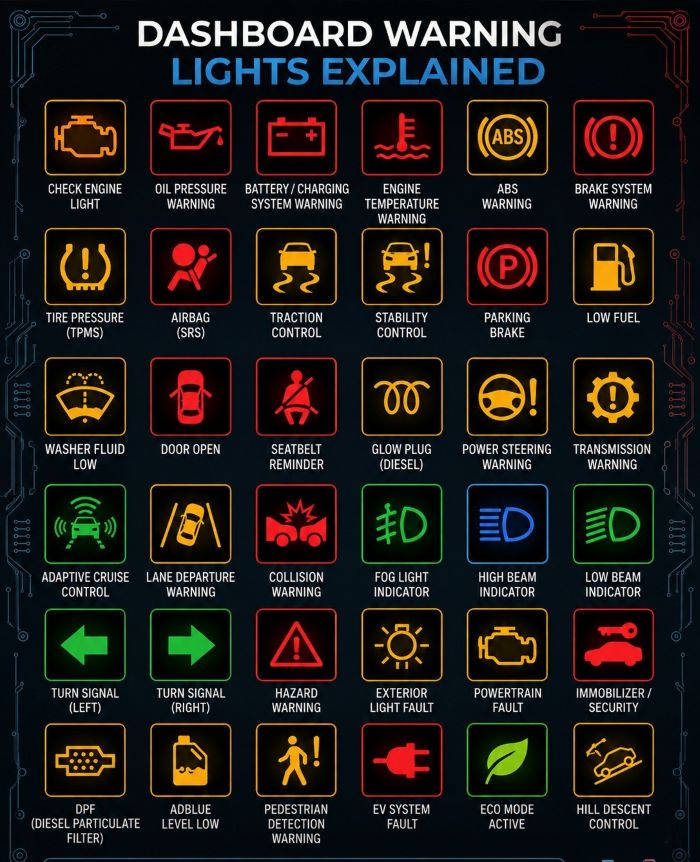
Your dashboard is essentially the car talking to you. Different manufacturers use slightly different symbols, but the basic principles are similar. Red warning lights generally mean stop and investigate immediately, and can include engine oil pressure, the brake system, engine overheating, the battery or charging system, and the seat-belt warning. A red warning light isn't always an automatic “engine destroyed” situation, but it should always be treated seriously.
The Red Oil-Pressure Light
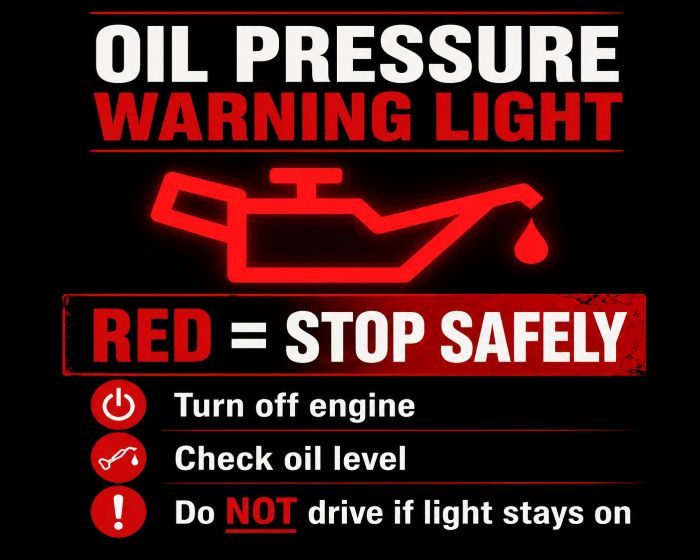
This is one of the lights every driver should understand. It usually looks like an oil can, and if it comes on while driving, don't simply assume “I need an oil change” — that's not necessarily what it means. It generally indicates a problem with oil pressure, which can be caused by low engine oil, an oil leak, a faulty oil-pressure sensor, a blocked oil passage, a failing oil pump, or internal engine wear. If it comes on, safely stop the vehicle, switch the engine off, allow it to sit for a few minutes on level ground, and check the oil level with the dipstick if the vehicle has one. If the oil is extremely low, that may explain the warning. But if the oil level is normal and the warning remains on, don't continue driving simply because there is oil in the engine — oil level and oil pressure are not the same thing, and continuing to run an engine with genuinely low oil pressure can cause severe internal damage.
Engine Temperature Warning
If the temperature gauge climbs toward the red zone or a temperature warning appears, you may have an overheating problem, possibly caused by low coolant, a coolant leak, a failed radiator fan, a faulty thermostat, a failed water pump, a blocked or damaged radiator, or a head-gasket problem. Signs of overheating include a rising temperature gauge, steam from the engine bay, a coolant smell, loss of engine power, a warning message, an unusually running cooling fan, or coolant leaking underneath the vehicle. If this happens, stop somewhere safe and turn the engine off. Do not immediately remove the radiator cap while the engine is hot — the cooling system can be pressurised and extremely hot coolant can cause serious burns. Let the vehicle cool, then inspect the coolant reservoir and look for obvious leaks. If the vehicle repeatedly overheats, don't keep driving it while simply adding coolant; the underlying problem needs to be diagnosed.
Check Engine Light
This is probably the warning light that causes the most confusion, since it can mean something relatively minor or something serious. Possible causes include a loose fuel cap, a bad oxygen sensor, a misfire, a faulty ignition coil, an injector problem, a catalytic-converter problem, a vacuum leak, a mass-airflow sensor problem, a throttle problem, or an emissions-system fault. The important thing is whether the light is steady or flashing. A steady light usually means the computer has detected a fault but the vehicle may still be driveable, and you should diagnose it soon. A flashing light should be treated much more seriously, since it can indicate a severe misfire capable of damaging the catalytic converter and potentially causing other problems — reduce driving and have the vehicle diagnosed promptly.
Battery Warning Light
The battery-shaped warning light is often misunderstood; it doesn't necessarily mean “replace your battery.” It often indicates a charging-system problem, which can involve alternator failure, a loose or broken drive belt, a wiring problem, battery failure, or another charging-system fault. If the alternator stops charging, the vehicle can continue running temporarily on battery power, but eventually the battery becomes depleted and the engine may stop — so a battery warning light while driving deserves prompt attention.
OBD-II: One of Your Most Useful Diagnostic Tools
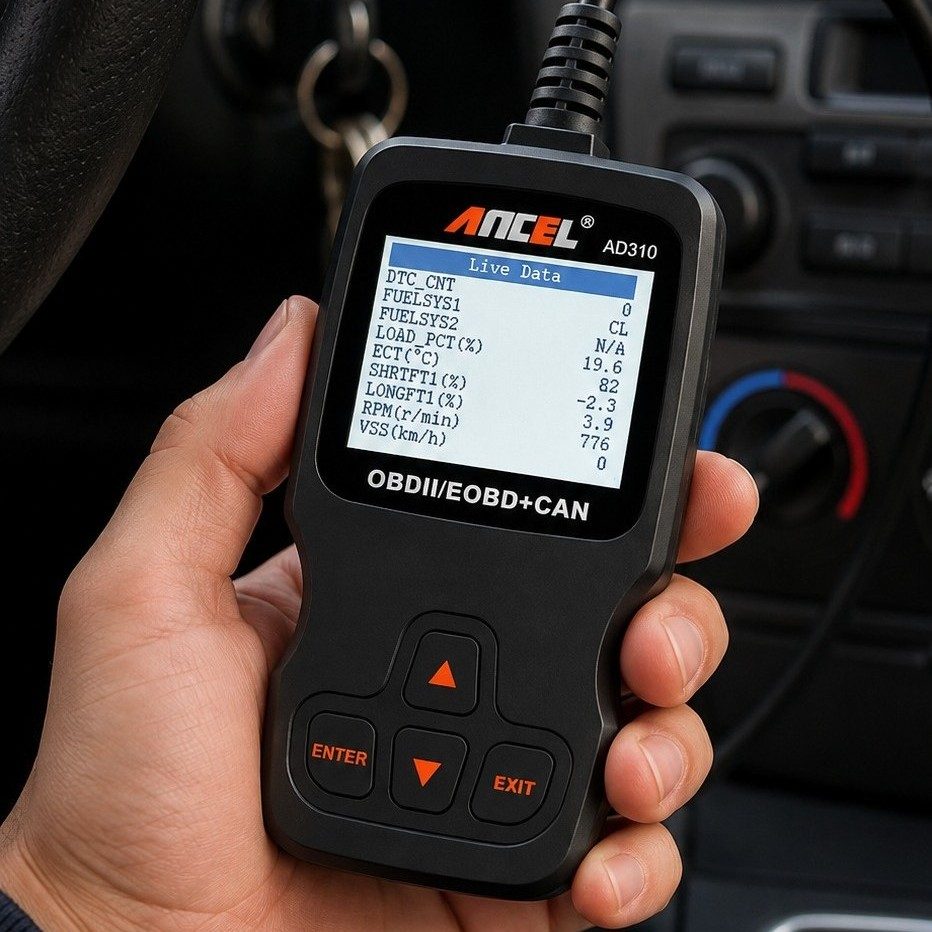
Modern cars have an onboard diagnostic system, and in many vehicles you can connect a scanner to the OBD-II port. The scanner communicates with the vehicle's computers and retrieves diagnostic trouble codes, commonly called DTCs. You might see a code such as P0301, which indicates a detected misfire associated with cylinder 1, or P0420, which generally relates to catalytic-converter efficiency. But here is a very important lesson: a diagnostic code usually identifies an area of the problem, not necessarily the component that needs replacing. If the scanner gives you a sensor-related code, don't automatically buy a new sensor — there may be broken wiring, poor electrical connections, vacuum leaks, low voltage, a mechanical problem, or another component causing the sensor to report abnormal conditions. The scanner is a starting point for diagnosis, not the final answer.
Starting Problems: “Won't Start” Isn't One Problem
This is one of the first troubleshooting situations every driver should understand. When you turn the key or press the start button, the first question is what actually happens.
Absolutely Nothing Happens
No clicking, no cranking. Possible causes include a dead battery, a poor battery connection, a faulty starter, a starter relay or fuse problem, an ignition or start-button problem, the gear selector not being in Park or Neutral, or an immobilizer or security-system problem.
Clicking, But the Engine Doesn't Turn
Possible causes include a weak battery, a poor battery connection, or a starter-motor problem. A rapid clicking sound often points toward insufficient battery voltage or current.
The Engine Turns Over But Doesn't Start
This is a different situation entirely — the starter is successfully turning the engine, so the investigation shifts to fuel, spark, air, engine timing, compression, the immobilizer, or sensor signals. This distinction is extremely useful, because “won't start” isn't one problem.
Slow Engine Cranking
If the engine sounds like a slow “rrr...rrr...rrr” and turns unusually slowly, suspect the starting system — potential causes include a weak battery, corroded terminals, a poor ground connection, a faulty starter motor, or thick or incorrect engine oil in some conditions. A battery test can determine whether the battery has sufficient capacity.
Engine Starts but Immediately Dies
Possible causes include a fuel delivery problem, an immobilizer issue, an airflow problem, a throttle-body issue, a sensor failure, a vacuum leak, or an ignition problem. If it starts for a second and then dies repeatedly, security or immobilizer systems are one possibility, and a diagnostic scan can be helpful.
Engine Symptoms: Idle, Misfires, Smoke, and Noises
Rough Idle
The engine should normally run smoothly when you're stopped. If the car shakes or the RPM constantly rises and falls, investigate the spark plugs, ignition coils, fuel injectors, vacuum leaks, throttle body, mass-airflow sensor, oxygen sensors, engine mounts, or compression problems. One of the most important clues is whether the engine itself is misfiring or whether it is running smoothly but the vibration is being transmitted through damaged engine mounts.
Engine Misfire
A misfire means combustion isn't happening correctly in one or more cylinders. You may notice shaking, loss of power, poor acceleration, the Check Engine Light, increased fuel consumption, or an uneven exhaust sound. Common causes include a worn spark plug, a bad ignition coil, a faulty injector, a vacuum leak, low compression, or a timing problem. A scan tool can often identify which cylinder is affected — for example, P0301 means a cylinder 1 misfire, P0302 means cylinder 2, and so forth.
Exhaust Smoke: White, Blue, and Black
Don't confuse normal condensation with persistent white smoke — a small amount of white vapour during a cold start can be normal, especially in cool conditions, but persistent thick white smoke can indicate coolant entering the combustion chamber, potentially caused by head-gasket failure, a cracked cylinder head, or a cracked engine block. The problem becomes more concerning if it is accompanied by coolant loss, overheating, milky engine oil, or a sweet-smelling exhaust. Blue or blue-grey smoke often indicates that the engine is burning oil, possibly due to worn piston rings, valve-stem seals, turbocharger oil leakage, or other internal engine wear, and the repair can range from relatively manageable to a major engine rebuild depending on the cause. Black smoke generally means the engine is receiving too much fuel relative to the amount of air being burned, possibly due to a faulty injector, a dirty air filter, a sensor problem, a fuel-pressure problem, or an engine-management fault; since modern electronically controlled engines normally regulate the air/fuel mixture carefully, persistent black smoke deserves diagnosis.
Engine Oil Disappearing or Turning Milky
If you keep adding oil between services, don't simply accept that “old engines consume oil.” Some oil consumption can occur, but excessive consumption should be investigated — possible causes include an external oil leak, worn piston rings, valve seals, a turbocharger problem, or a PCV-system problem, so it's worth checking underneath the vehicle for oil spots and inspecting around the valve cover, oil filter, oil pan, crankshaft seals and turbocharger area. If the oil on the dipstick or underneath the oil filler cap looks unusually creamy or milky, coolant contamination is one possibility, though short journeys in cold or humid conditions can sometimes create condensation under the oil cap — so don't diagnose a failed head gasket from the oil cap alone. Look at the complete picture: coolant loss, overheating, white exhaust smoke, oil condition, cooling-system pressure, and compression or leak-down results.
Strange Engine Noises
This is where experience becomes extremely useful, and different noises provide different clues. Ticking can suggest low oil level, valve-train noise, hydraulic lifters, injector noise, or an exhaust leak. A deep knocking sound from inside the engine can be serious, potentially involving internal bearing or combustion-related problems. Rattling could mean a loose heat shield, a timing-chain issue, an exhaust component, or an internal engine component. Squealing is often associated with the drive belt, belt tensioner, a pulley, or an accessory bearing. Never diagnose an engine based solely on the sound's name — the location and conditions matter just as much.
Transmission Problems
Your transmission transfers engine power to the wheels and allows the vehicle to operate at different speeds, and automatic transmissions in particular can develop several distinct symptoms.
• Delayed engagement: you select D but the car takes several seconds before moving — possible causes include low transmission fluid where applicable, a hydraulic pressure problem, a solenoid problem, internal wear, or a control-system fault
• Hard shifting: the car changes gear with a noticeable thump or clunk — possible causes include a transmission fluid problem, a solenoid problem, a transmission control issue, worn internal components, or engine problems affecting transmission behaviour; don't automatically assume the gearbox needs replacement
• Transmission slipping: engine RPM rises dramatically but the vehicle doesn't accelerate proportionally — this can indicate worn clutch packs, low fluid, hydraulic problems, or internal transmission wear, and deserves professional diagnosis
• CVT behaviour: instead of traditional fixed gears, a Continuously Variable Transmission continuously changes its ratio, so the engine may sound like it is holding a particular RPM while the vehicle accelerates — that isn't necessarily a fault, though shuddering, excessive RPM fluctuations, delayed acceleration, transmission warning lights or unusual noises are worth investigating; always use the manufacturer's specified service procedure and fluid
• Dual-clutch transmission (DCT) behaviour: DCTs use two clutches to provide very fast gear changes, but at low speeds some DCTs can feel different from traditional automatics without necessarily having a failure — persistent shuddering, slipping, grinding or severe jerking requires investigation
Braking Problems
Brakes are one area where it is never worth taking chances. Squealing can be caused by brake-pad material, dust, moisture, glazing, or worn pads. Grinding is more concerning, since it may mean the brake pad material has worn away and metal is contacting the rotor — stop and have the system inspected. A steering wheel that shakes while braking can point to brake rotor thickness variation, suspension problems, or wheel issues; the common phrase “warped rotors” is often used loosely, and proper measurement is better than guessing. A brake pedal that feels soft can indicate air in the hydraulic system, a brake-fluid leak, a hydraulic system problem, or a master-cylinder issue, and requires prompt attention.
Steering and Suspension
Your suspension controls how the vehicle's body moves and how the tyres remain connected to the road, with components including springs, shock absorbers or struts, control arms, bushings, ball joints, stabilizer links, tie rods, and wheel bearings.
Clunking, Bouncing, and Pulling
Clunking over bumps can point to worn bushings, ball joints, stabilizer links, shock or strut components, or other loose components. A car that bounces excessively after a bump may have worn shock absorbers or struts — a simple observation is whether the vehicle settles quickly after a bump or continues bouncing, which gives a clue even though it doesn't replace a full inspection. If the vehicle constantly pulls left or right, investigate tyre pressure, wheel alignment, tyre condition, brake dragging, and suspension components before paying for a wheel alignment.
Steering Wheel Vibration
The speed at which vibration occurs is an important diagnostic clue. Vibration mainly at highway speeds suggests wheel imbalance, a tyre problem, a bent wheel, or a suspension issue. Vibration mainly during braking points toward the brake system or wheel/suspension components. Vibration while accelerating could involve the driveshaft or CV joint, engine or transmission mounts, or the drivetrain more broadly. The timing of the vibration is itself diagnostic information.
Clicking While Turning and Wheel Bearing Noise
A repetitive clicking noise during tight turns, particularly while accelerating, can indicate a worn CV joint, which transfers power to the driven wheels while allowing the suspension and steering to move; a damaged CV boot can allow grease to escape and contamination to enter, and catching this early can make the repair much simpler than waiting until the joint fails. A worn wheel bearing may produce a humming or growling sound that changes as the vehicle turns — for example, becoming louder as the vehicle's weight shifts toward one side — and proper diagnosis is important because tyre noise can sound remarkably similar.
Tyre Problems
Never underestimate tyres — they are the only components physically connecting the vehicle to the road. Worth checking: tread depth, pressure, sidewall damage, cracks, uneven wear, bulges, age, correct tyre size, and correct load or speed rating. Uneven wear can indicate incorrect alignment, suspension wear, incorrect pressure, or tyre imbalance. A tyre with a bulge or serious sidewall damage should never be treated as a cosmetic issue.
Air-Conditioning Problems
If the AC isn't cold, don't immediately assume “it needs gas.” Possible causes include low refrigerant due to a leak, a compressor problem, a condenser problem, an evaporator problem, a blower problem, cabin filter restriction, an electrical fault, or a climate-control problem. If refrigerant is low, the important question is why it's low, since refrigerant shouldn't simply disappear under normal operation — repeatedly recharging the system without finding the leak isn't proper diagnosis
Electrical System Problems
Modern cars can have hundreds of electrical connections, and symptoms can include random warning lights, windows not working, central locking problems, interior lights staying on, infotainment restarting, the car refusing to start, or a battery repeatedly going flat. Possible causes include a weak battery, an alternator problem, a bad ground, a corroded connector, a blown fuse, wiring damage, a faulty module, or water intrusion. Electrical diagnosis requires patience.
Fuses
A fuse protects an electrical circuit — if too much current flows, the fuse is designed to fail. If your headlights stop working, for example, a fuse could be involved. But here is a critical rule: never replace a blown fuse with a higher-rated fuse just because the correct one keeps blowing. If the correct fuse repeatedly fails, there is probably an underlying electrical problem, and the fuse is simply doing its job.
Alternator and Starter Motor
The alternator generates electrical power while the engine is running and charges the battery; signs of a charging problem can include the battery warning light, dim lights, slow electrical accessories, a repeated dead battery, or the engine eventually stopping. A proper charging-system test should measure the system under appropriate conditions rather than simply replacing the battery. The starter motor, meanwhile, turns the engine when you start the vehicle — if the battery is healthy but the engine doesn't crank, the starter system becomes a major suspect, and a technician can test the starter circuit and voltage drop before replacing parts.
Fuel, Exhaust, and Emissions Problems
If an engine has fuel, air, ignition, correct timing and compression, it has the basic ingredients needed for combustion, so problems in this group tend to trace back to one of those elements.
Fuel System Problems and Poor Fuel Economy
Fuel-system problems can include a weak fuel pump, a clogged filter, a faulty injector, a fuel-pressure regulator problem, or contaminated fuel, with symptoms including hard starting, loss of power, stalling, poor acceleration, and misfires. If your vehicle suddenly starts using much more fuel, don't automatically blame the engine — investigate tyre pressure, driving style, traffic, the air filter, the oxygen sensor, injectors, the thermostat, brake drag, alignment, and fuel quality, since a vehicle running too rich can waste significant fuel.
Exhaust and Catalytic Converter Problems
The exhaust system removes combustion gases and controls emissions and noise, with components including the exhaust manifold, catalytic converter, oxygen sensors, diesel particulate filter, muffler, and exhaust pipes; symptoms of a problem include a loud exhaust, loss of power, the Check Engine Light, poor fuel economy, or a strong exhaust smell. The catalytic converter specifically reduces harmful exhaust emissions, and if it becomes blocked, the engine may struggle to breathe, causing poor acceleration, reduced power, excessive heat, or the Check Engine Light. A P0420 code doesn't automatically mean “replace catalytic converter” — a technician should investigate why the system isn't achieving expected efficiency.
Diesel Particulate Filter (DPF) and Limp Mode
Diesel vehicles can have a DPF that captures soot from exhaust gases, and the vehicle periodically needs to burn accumulated soot through a process called regeneration; problems can occur if the vehicle is used primarily for short, low-speed trips, with warning signs including a DPF warning light, reduced power, increased fuel consumption, frequent regeneration, or limp mode. Don't simply remove the DPF because it is causing problems — diagnose why regeneration isn't occurring properly. Limp mode itself is when the vehicle deliberately restricts performance because the computer has detected a problem, sometimes limiting the engine to a low RPM; possible causes include turbocharger problems, a transmission fault, sensor failure, a throttle problem, overboost or underboost, or a serious engine-management fault. Limp mode isn't itself the problem — it's the vehicle's response to a detected problem, so the correct move is to scan it.
Turbocharger Problems and Vacuum Leaks
Turbochargers use exhaust energy to compress intake air and increase engine performance; symptoms of a turbo problem can include loss of power, whistling, excessive smoke, oil consumption, the Check Engine Light, or poor acceleration, and a damaged turbo can sometimes contaminate the intake system with oil — though not every unusual turbo noise means the turbo needs replacement. Vacuum leaks occur when a cracked vacuum hose allows air into the engine where the computer isn't expecting it, causing rough idle, high idle, misfires, poor fuel economy, or the Check Engine Light; a professional may use smoke testing to locate difficult leaks.
Sensors: The Car's Nervous System
Modern vehicles depend heavily on sensors, including the oxygen sensor, mass-airflow sensor, manifold absolute pressure sensor, coolant-temperature sensor, crankshaft-position sensor, camshaft-position sensor, wheel-speed sensors, throttle-position sensors, and knock sensor. A sensor doesn't simply “tell the car what is happening” — its information is used by computers to make decisions. For example, the coolant-temperature sensor feeds the engine computer, which then adjusts fuel strategy; if the sensor sends incorrect information, the engine may behave incorrectly. If a sensor fails, the car may illuminate the Check Engine Light, enter limp mode, increase fuel consumption, run poorly, have difficulty starting, shift incorrectly, or disable some driver-assistance features. But again: don't replace a sensor just because a scan code mentions it — test the sensor and its circuit first.
Water Leaks and Strange Smells
If the carpet becomes wet, investigate immediately. Possible causes include blocked sunroof drains, a door-seal problem, a windshield seal issue, an AC drain problem, a heater-core leak, or a body seam leak, and water can damage wiring, control modules, carpets, sound insulation, and electronic connectors — modern vehicles contain electronics in places you wouldn't expect. Smells are diagnostic clues too: a sweet smell suggests a possible coolant leak, a burning oil smell suggests oil leaking onto hot components, a burning rubber smell suggests a belt or tyre problem, and a fuel smell suggests a possible fuel leak or fuel-system problem — a strong fuel smell should be treated seriously because fuel is highly flammable. A burning electrical smell suggests overheating wiring or an electrical component, and a rotten-egg smell can be associated with exhaust or emissions problems, or catalytic-converter-related conditions. Don't ignore unusual smells.
Basic Tools Every Car Owner Should Have
You don't need a professional workshop to troubleshoot a car sensibly. A useful basic toolkit includes:
• Tyre-pressure gauge
• Flashlight
• Basic socket set
• Screwdrivers
• Pliers
• Gloves
• Jack and proper jack stands
• Wheel chocks
• Digital multimeter
• OBD-II scanner
• Funnel
• Work light
• Vehicle-specific owner's manual
For anything involving lifting the vehicle, use proper jack stands and follow safe lifting points — never rely on a jack alone to support a vehicle while working underneath it.
The Multimeter
A multimeter is one of the most useful electrical diagnostic tools, allowing you to investigate battery voltage, continuity, resistance, voltage drops, and electrical circuits. But don't randomly probe circuits without understanding what you're measuring — incorrect multimeter settings or connections can damage components or create a short circuit.
The OBD Scanner
For modern vehicles, learning basic OBD scanning is strongly worthwhile. A scanner can provide diagnostic trouble codes, live sensor data, engine RPM, coolant temperature, fuel trims, oxygen-sensor information, misfire information, and system status. More advanced scanners can access multiple vehicle modules. A cheap scanner can be useful, but professional-level diagnostics can require much more sophisticated equipment.
Read the Owner's Manual
This sounds boring, but it isn't. Your owner's manual tells you the correct fluids, tyre pressures, fuse locations, warning-light meanings, service intervals, jacking points, recommended fuel, oil specification, towing limits, and reset procedures. Before troubleshooting a new car, it is worth reading the warning-light section first — it can save a lot of confusion.
Know Which Jobs You Can Reasonably Do Yourself
As a beginner, some maintenance is relatively approachable: checking tyre pressure, checking engine oil, checking coolant level when the engine is safely cool, replacing wiper blades, replacing some air filters, replacing some cabin filters, checking battery terminals, replacing certain bulbs depending on the vehicle, and reading diagnostic codes. Other jobs require substantially more knowledge, including brake hydraulic repairs, timing-belt replacement, engine internal repairs, transmission rebuilds, airbag systems, high-voltage EV systems, fuel-system repairs, and suspension components requiring specialised procedures. Know your limits.
Never Work Casually Around Airbags
Airbag systems contain pyrotechnic devices, and incorrect handling can cause serious injury. If an airbag warning light appears, have the system professionally diagnosed, and don't experiment with airbag wiring.
EVs Require a Different Level of Caution
Electric vehicles don't have conventional engines, but they still have brakes, suspension, steering, cooling systems, 12V batteries, high-voltage batteries, electric motors, inverters, and high-voltage cables. The orange high-voltage cables are a major warning sign: do not work on high-voltage EV systems unless you have the appropriate training and equipment. A high-voltage battery system is not a DIY project for someone learning basic car repair.
Keep reading on Modern Car Technology Explained: A Complete Buyer Guide
How Troubleshooting Knowledge Makes You a Better Used-Car Buyer
Knowing how to troubleshoot a car also makes you a better buyer. Before purchasing, ask the seller not to warm the vehicle before you arrive if possible, then observe the cold-start behaviour, any smoke, engine noise, and idle quality. During the test drive, check acceleration, gear changes, braking, steering, suspension and temperature. After driving, look underneath for oil, coolant, transmission fluid or other leaks. Then scan the vehicle, and ideally arrange an independent inspection before completing the purchase.
The Most Important Diagnostic Principle
If you remember only one thing about how to troubleshoot a car, remember this: a warning light tells you that the car has detected something — it does not automatically tell you which part to replace. A noise gives you a clue. A vibration gives you a clue. A diagnostic code gives you a clue. A fluid leak gives you a clue. Your job is to connect those clues. For example, “Check Engine Light + P0302 + rough idle” is far more useful than “my engine is bad,” and “battery warning light + dim headlights + repeated dead battery” is far more useful than “I need a new battery.” The first approach is diagnosis. The second is guessing.
Whenever your car behaves strangely, don't panic and don't immediately buy parts. Ask yourself what exactly happened, when it happens, whether it happens when the engine is cold or hot, whether it happens while accelerating, braking, turning or idling, what warning lights appeared, whether there are unusual sounds or smells or leaks, whether anything changed immediately before the problem appeared, whether you can safely perform a basic inspection, and what the diagnostic scan tells you. Then decide whether it is something you can safely handle yourself or whether it needs a qualified technician. That is how to troubleshoot a car with genuine confidence — not by memorising hundreds of parts, but by learning how to interpret symptoms, test possibilities, and make decisions based on evidence.