
Essential Factors to Evaluate When Buying a Luxury Sedan
Picture a parent explaining their situation like this: “I have young children, I need something safe and reliable, I need enough space for strollers and car seats, but I also want the car to look stylish and feel luxurious.” A good advisor would not start by asking which brand you like. Instead, they would explain that a luxury sedan is not simply a more expensive car — you are paying for a combination of safety, comfort, engineering, materials, technology, driving experience, reliability and prestige, and for a family, some of those qualities matter far more than others. Below are the essential factors to evaluate when buying a luxury sedan, organized into distinct groups, along with why each group matters.
Group 1: Safety — Protecting Your Family
For a family with young children, safety comes before leather seats, large screens, horsepower or a prestigious badge, which is why it is the first and most significant group among the essential factors to evaluate when buying a luxury sedan. Within this group, it helps to look at both the car's ability to prevent an accident and its ability to protect your family if one happens.
Crash-Test Performance
It is worth checking how the specific model and year performed in independent crash testing, covering frontal crash protection, side-impact protection, protection in rear-end collisions, rollover resistance, protection of children, and protection of occupants in different seating positions. Importantly, check whether the safety rating applies to the exact generation and model year under consideration, since a 2026 model can have substantially different safety equipment from a 2021 version of what appears to be the same car.
Airbags
A family car should have a comprehensive airbag system. Depending on the vehicle, this can include front airbags, side airbags, curtain airbags, knee airbags, and rear-seat side airbags. Curtain airbags deserve particular attention because they can help protect occupants during side impacts and rollovers.
Automatic Emergency Braking
This is a technology worth taking seriously. If you are driving with children in the car and traffic suddenly stops, the system can warn you and, depending on the vehicle, automatically apply the brakes if you do not react quickly enough. It is worth checking whether it works with cars, pedestrians, cyclists, stationary objects, and vehicles at night, because not all “automatic emergency braking” systems are equally capable.
Blind-Spot Monitoring and Adaptive Cruise Control
Blind-spot monitoring warns you when another vehicle is sitting where you may not easily see it, and some systems also provide rear cross-traffic warnings when reversing out of a parking space, which is particularly useful in shopping centers and crowded parking lots. Adaptive cruise control, meanwhile, maintains a selected distance from the vehicle ahead — for example, if you set the system to maintain 50 meters and traffic slows down, the car slows with it — which reduces fatigue on longer journeys, though it remains a driver-assistance system rather than a self-driving one.
Lane-Keeping Assistance
This can help prevent the vehicle from unintentionally drifting out of its lane, which can be useful for a parent driving long distances with tired children in the back. However, as with adaptive cruise control, these systems assist the driver; they do not replace the driver.
Group 2: Family Fit and Practicality
This second group is where many buyers make a mistake, often assuming that because a sedan looks large, children's seats will obviously fit. Not necessarily. It brings together child-seat compatibility, interior space, boot space, and everyday family convenience — in other words, whether the car actually works for your day-to-day life rather than just looking spacious in a showroom.
Child-Seat Compatibility
This is extremely important for a family's situation, and the only reliable way to judge it is to physically test your actual child seats in the car rather than assume it will work. Depending on the market, you may see ISOFIX or LATCH terminology — these are standardized systems that allow compatible child seats to attach directly to the vehicle. Worth checking: how many mounting positions are available, whether they are easy to access, whether the anchors are clearly marked, and whether your particular child seat fits correctly.
Some child seats also require a top tether, so it is worth checking where the tether anchor is located and whether installing the seat leaves enough room for passengers. Rear-seat space is more complicated than simply measuring legroom: a rear-facing infant seat can extend significantly toward the front seat, and if the driver is tall, installing the child seat behind the driver may force the driver's seat too far forward. For that reason, the most reliable test is to put the child seat in the actual car and work through it step by step — adjust the driver's seat for the main driver, install the child seat behind it, adjust the front passenger seat normally, install a second child seat if necessary, and check whether both adults remain comfortable. That real-world test is far more valuable than a brochure's “rear legroom” figure.
Interior Space and Rear-Seat Practicality
A luxury sedan can look enormous from outside and still be surprisingly inconvenient for a family, so it helps to think through several distinct areas. For rear-seat width, consider how many children you have and whether you will eventually need one child seat, two child seats, two child seats plus an adult, or three child seats across — two seats can fit comfortably in a sedan while three across may be extremely difficult, and if you have three young children, a larger SUV or MPV may make more sense.
Door opening sounds trivial until you have a child in your arms: a good family car should allow you to open the rear doors widely enough to install a child seat, strap a child in, lift a sleeping child out, load bags, and reach the rear seat comfortably. Rear-seat access matters too — a low luxury sedan can have excellent handling but may require more bending than a higher vehicle, which matters when you are doing the school run every day.
Boot or Trunk Space — Don't Judge It by Liters Alone
Needing space for strollers changes the way the boot should be evaluated. Manufacturers may advertise something like “500 liters of luggage capacity,” which sounds impressive, but the number does not tell you whether your stroller actually fits. It is worth physically testing your stroller, shopping bags, diaper bag, school bags, emergency equipment, groceries, and suitcases if you travel.
The boot opening is extremely important, since a sedan may have a large boot but a relatively narrow opening, meaning your stroller might technically fit inside but be difficult to insert — which is why testing the actual stroller is preferable to trusting a spec sheet. Bring the stroller when shopping for the car, fold it, put it into the boot, and ask how much space remains; that tells you far more than the manufacturer's luggage-capacity figure. Finally, look for split-folding rear seats, such as a 60/40 split, which allow you to carry longer objects while still retaining a passenger seat — for a family, that is much more useful than a beautiful but completely fixed rear seat.
Family Convenience in Everyday Life
Beyond the specification sheet, it helps to ask how the car fits into your actual life. Can you easily install the children on the morning school run? Can the stroller and groceries fit together for shopping? Can luggage fit without filling the cabin on a weekend trip? Can you fit suitcases for an airport trip? Can you put children into their seats without struggling on a rainy day? Are the headlights and cameras good for night driving? Are the seats comfortable for several hours on a long trip? These practical questions often reveal more than a specification sheet ever could.
Group 3: Reliability and Long-Term Ownership Costs
A luxury car can be an excellent vehicle and still be an expensive vehicle to own, which makes this group just as significant as safety when it comes to the essential factors to evaluate when buying a luxury sedan. Rather than relying on generalizations such as “Toyota is reliable,” “BMW isn't reliable,” or “Mercedes is expensive” — statements that are far too simplistic — it is better to investigate the reliability of the specific engine, transmission and generation.
Engine, Transmission, and Electronics
For the engine, worth investigating: known engine problems, oil consumption, cooling-system problems, timing-chain issues, turbocharger reliability, common leaks, known recalls, and typical lifespan. For the transmission: the type of transmission, known failure points, service requirements, repair costs, shift quality, and reliability at higher mileage. Modern luxury cars also contain enormous amounts of electronics, so it is worth checking the reputation of infotainment systems, digital dashboards, cameras, sensors, electric seats, power doors, climate-control electronics, and driver-assistance systems — a mechanical problem is one thing, but a fault involving several interconnected electronic systems can be much more expensive.
Maintenance and Repair Costs
This is where it is worth challenging the idea of buying “the nicest car you can afford” and instead buying the nicest car you can comfortably maintain. Imagine two cars that both cost $40,000 used: one might require $1,000 a year in maintenance, while the other could occasionally require $4,000–$6,000 repairs — the purchase price alone does not tell you which is more affordable. It is worth investigating oil-service costs, brake costs, tyre costs, battery replacement, suspension components, major service intervals, transmission servicing, parts availability, and specialist labour rates, and importantly, checking whether parts are readily available in your country, since a car can be extremely reliable in Germany but frustrating to own somewhere its specialized parts are difficult to obtain.
Fuel Economy and Engine Choice
A luxury vehicle does not necessarily need a huge engine, so it is worth considering how much you actually drive. Petrol engines are generally smooth and familiar, though fuel consumption can be higher depending on the engine. Diesel can make sense for substantial highway mileage, but modern diesels can have additional emissions-related systems that require consideration. Hybrids can be excellent for urban family driving because the electric motor reduces fuel consumption during stop-and-go traffic, while plug-in hybrids can provide electric driving for shorter trips while retaining an engine for longer journeys — though it is worth examining battery health, charging availability, and the complexity of the system. A fully electric vehicle can be exceptionally quiet and smooth, and for a family it is worth evaluating real-world range, charging speed, home charging, public charging availability, battery warranty, battery degradation, boot space, rear-seat space, and long-distance practicality.
Insurance and Resale Value
Before buying the car, it is worth getting an insurance quotation, since a $50,000 luxury car can have very different insurance costs from another $50,000 car — insurers weigh vehicle value, theft risk, repair costs, engine size, driver profile, location, and safety equipment, and it is best never to buy the vehicle first and discover the insurance cost afterward. It is also worth asking what happens when you want to sell the car, since some luxury vehicles lose value much faster than others; examine demand for the model, brand reputation, reliability reputation, parts availability, mileage sensitivity, service history, age, and import restrictions where applicable, because a car that costs slightly more today but retains substantially more value can sometimes be cheaper over the period you own it.
Buying Used: Service History and Inspection
If buying used, this becomes critical. Worth requesting: service records, previous repair invoices, mileage history, accident history, ownership history, recall completion, and inspection reports. From there, an independent mechanic — not the seller's mechanic, and not simply the salesperson — should inspect the engine, transmission, suspension, brakes, steering, cooling system, electrical system, air conditioning, tyres, undercarriage, and accident repairs, and scan the car electronically for stored diagnostic faults.
Tyres and Wheels
This is another hidden luxury-car expense. Large wheels look fantastic, but they can mean more expensive tyres, less sidewall protection, greater susceptibility to pothole damage, a harsher ride, and more expensive replacement wheels. For a family car, it is worth resisting the automatic pull toward the biggest wheels available, since sometimes a slightly smaller wheel with a taller tyre gives a better combination of comfort, durability and cost.
Cost of Ownership — The Number Most Buyers Forget
Rather than comparing purchase prices alone, it is worth calculating the approximate five-year ownership cost by adding the purchase price, insurance, fuel or electricity, routine servicing, tyres, and brakes, then adding unexpected repairs and subtracting the expected resale value to arrive at an approximate cost of ownership. This single calculation is a much better way to compare cars than simply comparing sticker prices.
Group 4: Comfort and Driving Experience
This is one of the areas where luxury sedans can genuinely excel, and it covers comfort, ride height, driving and handling, visibility, climate control, and noise — in short, what it actually feels like to live with the car day to day.
Comfort: Seats and Suspension
Comfort is not just “soft seats.” For seat design, worth checking cushion length, lumbar support, side support, seat firmness, driving position, and adjustment range — if you regularly drive two or three hours, a beautiful interior does not matter if your back hurts after 45 minutes. For suspension, a luxury sedan should ideally absorb speed bumps, potholes, rough roads, expansion joints, and uneven surfaces, though there is a balance: a very soft car can feel unstable, while a very sporty suspension can be uncomfortable for a family, so controlled comfort is usually the right priority.
Ride Height and Road Conditions
This is particularly important depending on where you drive. A luxury sedan generally sits lower than an SUV, which can provide better handling, a lower center of gravity, and easier high-speed stability, but it can also create problems with deep potholes, high speed bumps, rough roads, steep driveways, and flooded roads. It is worth inspecting the actual roads you use every week — if your daily route includes rough roads, a beautiful low-slung luxury sedan may not be the smartest family choice.
Driving and Handling
Even though it is a family car, it should still be enjoyable to drive. Worth evaluating: whether the steering feels precise, whether the car stops confidently under braking, whether acceleration provides enough power for overtaking, joining highways, climbing hills, and carrying a full family and luggage, and whether the vehicle feels planted and calm rather than nervous at highway speed. You do not need 500 horsepower — you need predictable, sufficient power.
Visibility
This is often overlooked. A family car should make it easy to see what is happening around you, so it is worth inspecting front visibility, rear visibility, A-pillars, side mirrors, blind spots, the rear camera, and any 360-degree camera — a 360-degree camera can be particularly useful when parking a large luxury sedan in tight spaces.
Climate Control
For a family, this deserves its own attention. Worth checking: dual-zone climate control, three-zone or four-zone climate control, rear vents, rear temperature controls, effective air conditioning, and fast cabin cooling. If you live somewhere hot, air-conditioning performance becomes especially important, so it is worth actually sitting in the rear seat and testing the airflow.
Noise and Refinement
One of the major reasons people buy luxury cars is how they feel inside. At highway speed, it is worth listening for tyre noise, wind noise, engine noise, suspension noise, and vibrations — a good luxury sedan should create a quiet environment, which becomes especially valuable when children are sleeping in the back.
Group 5: Technology and Security
Technology should make family life easier, not simply make the brochure look impressive, and this group also covers protecting the vehicle itself.
Technology
Worth looking for: Apple CarPlay, Android Auto, Bluetooth, USB-C charging, multiple charging ports, rear climate controls, navigation, wireless phone charging, parking cameras, parking sensors, keyless entry, and remote start where supported. For children, rear USB charging can become surprisingly useful. It is also worth considering whether the technology is reliable and intuitive — a screen with 50 functions is not necessarily better than a system that lets you adjust the temperature quickly.
Security
Depending on where you live, theft risk is worth considering. Worth investigating: the immobilizer, alarm system, key security, GPS tracking compatibility, insurance theft rates, availability of replacement keys, and whether the model is frequently targeted for theft. This is not glamorous, but it is part of responsible car ownership.
Group 6: Interior Materials and Durability
Luxury is not simply about expensive-looking materials, and with young children in the car, this group carries particular weight. Family life means spilled drinks, food crumbs, mud, shoes against seat backs, toys, fingerprints, and the occasional accident, so it is worth evaluating whether the interior is beautiful and practical. Light-colored leather may look fantastic but require more maintenance, while dark interiors tend to hide dirt better. It is also worth looking at leather quality, stitching, plastic quality, door-panel materials, seat durability, floor mats, and ease of cleaning — for a family, the preference should be luxury that can survive family life.
Group 7: Style, Identity, and Brand
Only after dealing with safety, reliability and practicality should styling move to the center of the decision. Because reflecting your own identity matters too, this final group is about making sure the car fits your personality without compromising the family requirements covered above.
Style and Personal Identity
It helps to ask what kind of image you want the car to project. Elegant and understated means something sophisticated that does not attract excessive attention. Sporty and youthful means aggressive styling, sharper handling and a more dynamic appearance. Executive means a formal, prestigious appearance. Modern and technological means a minimalist interior, large screens and advanced technology. Powerful and imposing means large proportions and a strong road presence. There is no objectively “best” luxury design — the right one is the one that fits your personality.
Brand Reputation
The badge matters, but not as much as people think. Brands worth considering include BMW, Mercedes-Benz, Audi, Lexus, Genesis, Volvo, Jaguar, Cadillac, Acura, and Infiniti, depending on your market, but rather than saying “buy Lexus because Lexus is reliable,” it is better to examine the particular model, generation, engine, transmission, mileage, and service history of the specific car in front of you. The same principle applies to every manufacturer.
The Family Stress Test
Before committing to a purchase, it is worth running what could be called a practical family test. Take the actual car and bring your children's car seats, your stroller, a normal family shopping load, and a couple of bags. Then perform your normal routine: put the child seats in, put the stroller in the boot, put the children in, adjust the front seats, open and close the doors, reverse into a parking space, and try getting everyone out. Then ask yourself: could you happily do this every day for the next five years? That answer is often more valuable than a salesperson's presentation.
How to Rank These Groups for Your Situation
For a family with young children, the essential factors to evaluate when buying a luxury sedan can be roughly prioritized as follows:
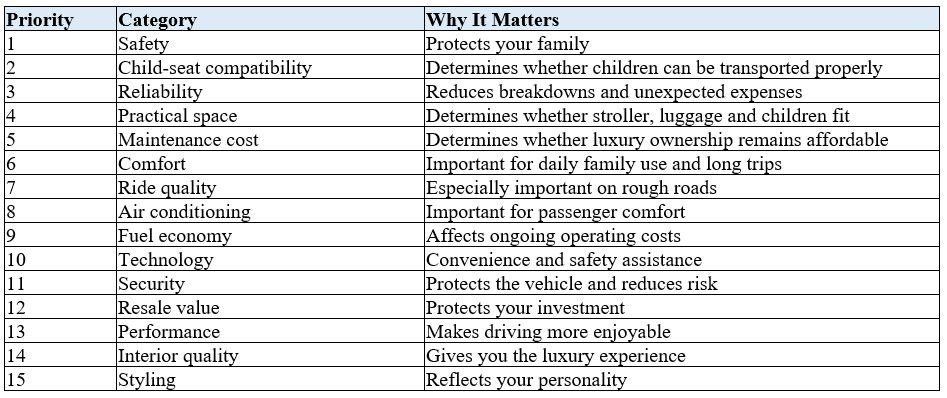
Notice that styling is not at the top. That does not mean style is unimportant — it means the goal is to avoid buying a beautiful car that becomes a daily frustration because the stroller does not fit, the child seats are difficult to install, or maintenance is financially painful.
The Final Five Questions to Ask Yourself
After weighing every group above, the entire decision can be reduced to five questions.
- Will it protect my family?
- Can my children and their equipment fit comfortably?
- Can I afford to maintain it properly?
- Will it handle the roads and driving conditions I actually face?
- Do I genuinely enjoy owning and driving it?
If the answer to all five is yes, it is time to start talking seriously about which luxury sedan fits your family.
Useful Tips: How to Freshen Car Interior and Remove Bad Odors for Good
Final Thoughts
Don't shop for a luxury sedan based on the badge first. Shop based on the life you want the car to support, then use the badge, styling and features to narrow the choices. Working through these essential factors to evaluate when buying a luxury sedan, group by group, is what separates a car that merely looks impressive in a showroom from one that genuinely fits your family. A car that looks impressive but does not work for your family is not a luxury — it is an expensive inconvenience.