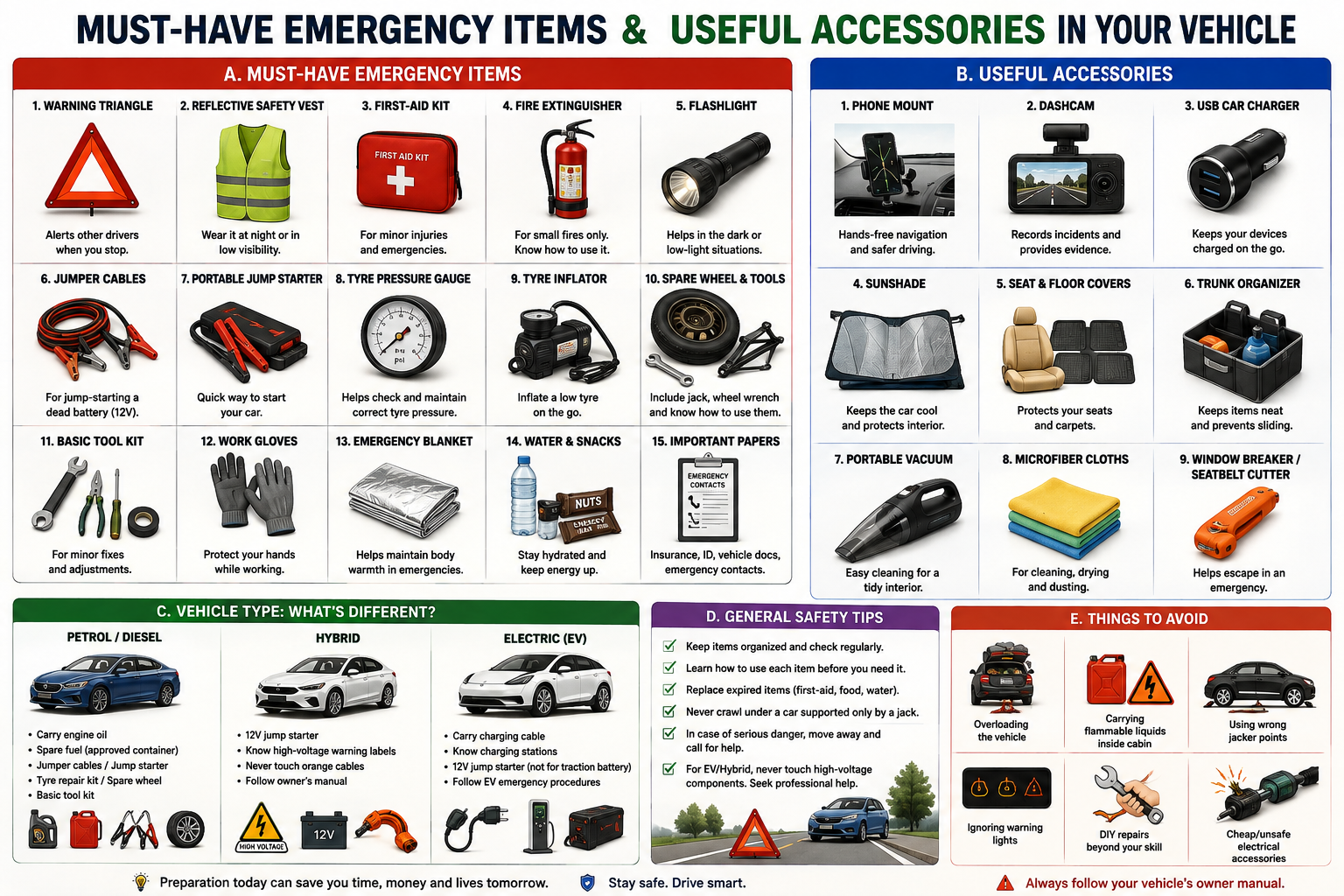
Warning Triangle
This is one of the first things worth putting in the vehicle. If your car breaks down on a road, especially at night or around a blind corner, other drivers need to know that your vehicle is stopped ahead. A reflective warning triangle can be placed at an appropriate distance behind the vehicle, subject to local road-safety rules. Its purpose isn't to fix the car — its purpose is to prevent another vehicle from hitting you.
Reflective Safety Vest
A reflective vest is particularly useful if you need to leave the vehicle at night or on a busy road, since without reflective clothing, a driver approaching from behind may not see you clearly. It is worth keeping the vest somewhere you can reach before getting out of the car — the glove compartment, a door pocket, or the centre console — rather than buried underneath luggage in the boot.
Medical and Fire Safety
First-Aid Kit
A proper first-aid kit is one of the most important items in any vehicle. A basic kit can contain adhesive bandages, sterile gauze, medical tape, antiseptic wipes, disposable gloves, small scissors, tweezers, sterile dressings, a burn dressing, an emergency blanket, and a CPR face shield if you are appropriately trained to use one. The exact contents should reflect the people travelling in the vehicle — for a family car, consider children's needs as well — and it is worth checking the kit periodically, since medical supplies expire or become damaged by heat.
Fire Extinguisher
A small automotive fire extinguisher can potentially help with a small, developing fire, but a fire extinguisher is not a reason to approach a large vehicle fire. If you see heavy smoke, flames spreading rapidly, battery involvement, fuel leaking, or explosions or popping sounds, move away and call emergency services. For an EV or hybrid, a conventional small extinguisher is not a substitute for a professional response to a high-voltage battery fire, and you should never put yourself in danger trying to save the vehicle.
Lighting and Backup Power
Flashlight
A flashlight becomes extremely valuable when something happens at night, letting you inspect tyres, the engine compartment, fluid leaks, the battery area, and your roadside surroundings. A rechargeable flashlight with a strong beam and a backup power source is worth prioritising, and a headlamp is even better because it leaves both hands free.
Extra Batteries or Power Bank
If your flashlight is rechargeable, don't depend entirely on the vehicle's electrical system — carry a power bank, a charging cable, and spare batteries if applicable. This is particularly useful if the vehicle's 12V system has failed.
Phone Charger
A dead phone during a roadside emergency is a serious inconvenience, so keep a vehicle charger suitable for your phone. USB-C charging is increasingly useful because many modern phones use USB-C. Ideally, carry phone, cable and power bank together — that combination is much more useful than a charger alone.
Basic Roadside Tools
Basic Roadside Tool Kit
You don't need dozens of tools. A compact kit can contain screwdrivers, pliers, an adjustable wrench, basic sockets, work gloves, electrical tape, cable ties, a utility knife, and a small adjustable spanner. But remember: tools are for basic problems you understand, not for attempting major roadside repairs.
Work Gloves
A surprisingly useful item on its own, protecting your hands from dirt, hot components, sharp edges, grease and tyre debris. Keep one pair in the emergency kit.
Tyre Care Essentials
Tyre Pressure Gauge
Every driver should know how to check tyre pressure, since incorrect pressure can affect fuel consumption, EV range, handling, braking, tyre wear and overall safety. Don't guess tyre pressure by looking at the tyre — use a pressure gauge. The correct pressure is normally specified by the vehicle manufacturer, often on a sticker around the driver's door area or in the owner's manual.
Portable Tyre Inflator
This is one of the most practical accessories a driver can own. A portable compressor can help if a tyre has gradually lost pressure — for example, discovering a tyre at 20 PSI when it should be 35 PSI. If there is no major puncture, you can inflate it to the manufacturer's recommended pressure and proceed to a tyre shop. But understand the difference between slow air loss and major tyre damage: if the tyre has a large puncture, sidewall damage or a bulge, inflating it and continuing to drive may be dangerous.
Spare Wheel, Jack, and Wheel Chocks
If your vehicle comes with a spare wheel, know where it is before you need it — learn how to access the spare wheel, jack, wheel wrench and jacking points, and check the spare tyre's condition periodically, since a spare that has been sitting untouched for years isn't necessarily ready for emergency use. A jack is necessary if you're going to change a conventional wheel yourself, but there is an extremely important safety rule: never crawl underneath a vehicle supported only by a jack; if working underneath a vehicle requires support, use properly rated jack stands and appropriate procedures. Wheel chocks help prevent a vehicle from moving while it is being worked on and are especially useful on slopes, although the safest option for a roadside repair is to move to a stable, safe location whenever possible.
Tyre Repair Kit
Some vehicles don't come with spare wheels; instead they may have tyre sealant, a compressor, or a tyre repair kit. These can be useful for certain punctures, but tyre sealant isn't appropriate for every type of damage and generally shouldn't be treated as a permanent replacement for proper tyre repair or replacement — a sidewall puncture or major tyre damage may require a new tyre.
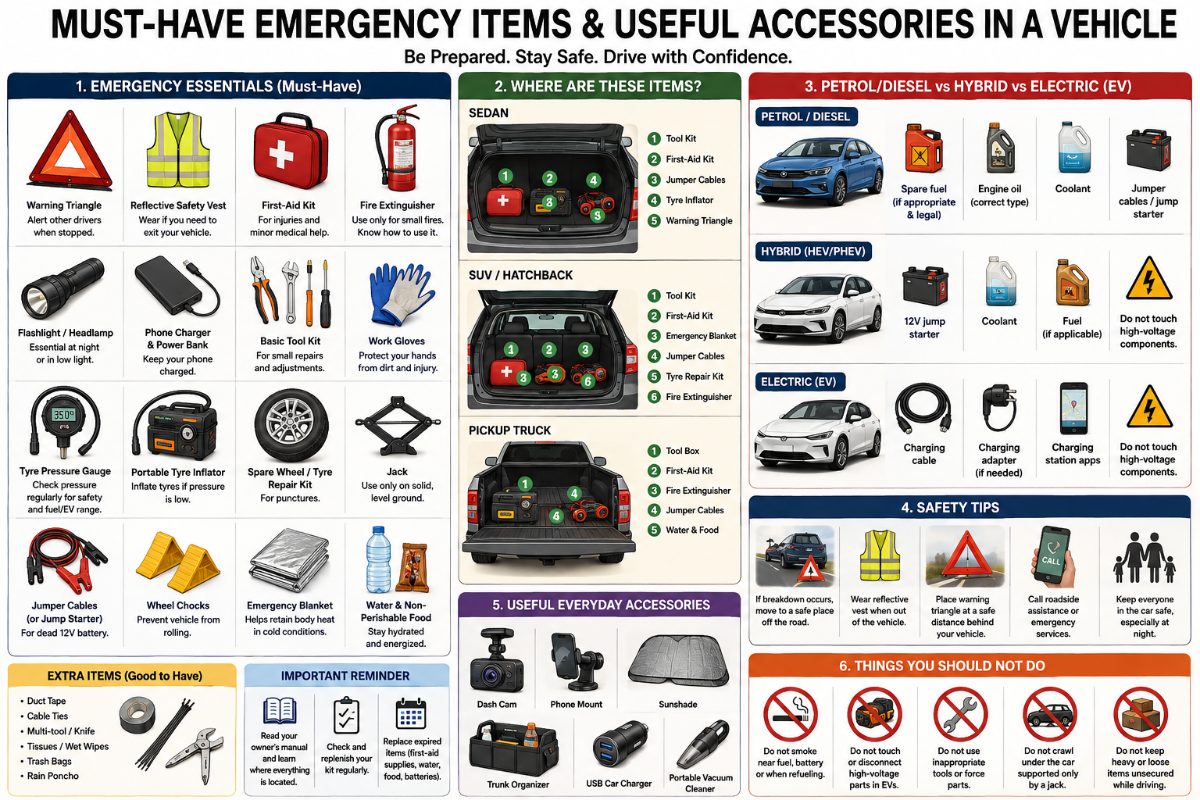
Electrical and Jump-Starting Equipment
Jumper Cables
For petrol or diesel vehicles with a conventional 12V battery, jumper cables can be useful if the battery has gone flat. However, modern cars can have sensitive electronics, so you need to understand the correct positive and negative connections, which vehicle can provide the jump, the correct connection sequence, and any manufacturer restrictions. Don't randomly connect cables based only on cable colour.
Portable Jump Starter
For many drivers, a quality portable jump starter is preferable to depending entirely on finding another car. It can be stored in the vehicle and used when the 12V battery is too weak to start the car. But there is an important distinction for EVs and hybrids: a 12V jump starter is for the 12V system, and it is not a device for jump-starting the high-voltage traction battery. For an EV, follow the manufacturer's procedure and use the designated 12V jump points if emergency 12V assistance is permitted.
Tow Strap or Recovery Equipment
A recovery strap can be useful in appropriate circumstances, but don't simply attach it to any convenient metal component underneath the car — vehicles have designated recovery or towing points, and the owner's manual should tell you where they are. Also remember that some vehicles have restrictions on towing distance, towing speed, whether the vehicle can be flat-towed, and whether all four wheels can remain on the ground, which is particularly important with automatic transmissions, AWD systems, hybrids and EVs. When in doubt, use professional recovery.
Comfort and Sustenance for a Breakdown
An emergency blanket takes very little space and can help keep someone warm in a breakdown situation, and can also provide basic protection from weather while waiting for assistance. It is worth keeping some drinking water in the vehicle, particularly for long journeys — though it's worth avoiding leaving large quantities of plastic bottles exposed to extreme heat indefinitely, and rotating your emergency supplies; for family travel, carry enough water for the passengers rather than assuming roadside shops will always be available. For long-distance driving, especially through areas with limited services, consider energy bars, crackers, nuts or other non-perishable foods, which becomes more important if you're travelling with children. A surprisingly useful group of items is basic hygiene supplies — tissues, wet wipes, hand sanitizer, disposable bags, toilet paper and paper towels — which aren't mechanical tools, but are extremely useful when you're stuck somewhere.
Information and Documentation
Don't rely exclusively on your phone. Consider keeping a small card containing emergency contacts, insurance information, your breakdown or recovery provider, vehicle registration information, important medical information where appropriate, and a family contact, while keeping sensitive information limited and secure.
The vehicle owner's manual is one of the most underrated emergency tools of all. It can tell you the correct tyre pressure, jacking points, fuse locations, fluid specifications, battery location, warning-light meanings, towing instructions, jump-start procedure, spare-wheel procedure, and EV charging information. For a first-time car owner, the manual is genuinely worth considering part of the emergency kit.
Diagnostic Tools
OBD-II Scanner
For a petrol or diesel car, a basic OBD-II scanner can be useful — if the Check Engine Light appears, it may allow you to read the diagnostic trouble code. For example, code P0301 can indicate a detected misfire on cylinder 1. But remember: the code is a clue, not necessarily the failed component. An OBD scanner is useful for understanding what the vehicle has detected, not for blindly replacing parts, and some EVs and hybrids use manufacturer-specific diagnostic systems, so a basic generic OBD scanner may have limited access.
Multimeter
A digital multimeter can be useful for people who are comfortable with basic electrical troubleshooting, helping check 12V battery voltage, charging voltage, continuity, and certain electrical circuits. For a complete beginner, however, this is best considered an optional tool rather than a must-have emergency item, and it should never be used casually around high-voltage EV systems.
Temporary-Fix Items — Used With Caution
Duct tape and cable ties won't permanently repair a vehicle, but they can be useful for temporary non-safety-critical fixes, such as securing a loose plastic undertray or trim temporarily. Never use tape or cable ties as a substitute for repairing brake components, steering components, tyres, fuel lines, high-voltage cables, or structural components.
For petrol or diesel vehicles, depending on the manufacturer's requirements, carrying a small amount of the correct engine oil and coolant can sometimes be useful, but don't simply pour any fluid into the car — you need the manufacturer's specified product, since different coolant types should not automatically be mixed, and you should never open a hot pressurized cooling system.
Some drivers carry a small approved fuel container for petrol or diesel emergencies. If you do this, use only a properly approved fuel container and follow local safety requirements — never transport fuel in an ordinary plastic bottle or unsuitable container, and never store fuel in the passenger compartment, since carrying fuel creates its own fire and vapour hazards. In many situations, roadside fuel delivery or recovery is safer.
Equipment Specific to Electric Vehicles
Charging Cable and Adapter
This is one of the most important EV-specific items. Know exactly what charging connector your vehicle uses — depending on the vehicle and market, you may encounter systems such as Type 2, CCS, or other manufacturer or market-specific connectors — and make sure your vehicle's charging cable is appropriate for the charging equipment you intend to use. Don't buy an adapter simply because the connector physically fits; the electrical specifications must also be compatible. Before purchasing an adapter, check the connector type, AC/DC compatibility, voltage, current rating, vehicle compatibility, and charger compatibility, since an adapter isn't automatically safe just because it physically connects.
Charging Apps and Extension Cables
For an EV driver, your phone becomes part of your emergency equipment. Before a long journey, it's worth knowing where charging stations are located, which charging networks operate in the area, which connector they use, whether the station supports your vehicle, whether payment is required, and whether the station is currently operational — don't plan an EV journey based purely on the assumption that “there's a charger somewhere along the road.” Plan around actual charging locations and have a backup option. It's also worth being careful with extension cables: don't assume you can safely use an ordinary household extension cable for EV charging, since EV charging can involve substantial continuous electrical loads, so use manufacturer-approved or appropriately rated charging equipment and follow the charging equipment's instructions.
Know Your EV's Emergency 12V Procedure
Every EV owner should know where their 12V battery is and where the approved 12V jump points are located. The traction battery may be full, but if the 12V system is dead, the vehicle may not operate normally, so it is worth learning the manufacturer's emergency procedure before you need it.
Equipment Specific to Hybrids
Hybrid owners should similarly understand their vehicle's 12V battery location, emergency starting procedure, high-voltage warning labels, high-voltage cable identification, and recovery or towing instructions. Don't attempt to disconnect the high-voltage system just because the vehicle won't start.
Everyday Convenience Accessories
Beyond emergency preparedness, several accessories genuinely improve everyday driving, though they aren't safety equipment on their own.
• Dashcam: provides video evidence of traffic incidents, accidents, dangerous driving and road conditions; a good dashcam should have a front camera, good night performance, automatic recording, loop recording, reliable storage, and optional parking mode, and should be wired properly rather than leaving cables dangling around airbags or pedals
• Phone mount: allows navigation without holding the phone; place it somewhere that doesn't obstruct your view, block airbags, interfere with controls, or create a dangerous distraction — the goal is safer navigation, not watching videos while driving
• USB-C car charger: keeps a phone, navigation device, power bank or other small electronics charged during long journeys; use a reputable charger rather than the cheapest unbranded unit
• Portable air compressor: useful enough to count as both an emergency item and an everyday accessory, helping maintain tyre pressure without finding a petrol station or tyre shop; look for the correct pressure range, automatic shutoff, digital pressure display, suitable power connection, and adequate cable length
• Sunshade: in hot climates, a windshield sunshade can significantly reduce cabin temperature, protecting the dashboard, steering wheel, seats and electronics, and making getting back into the vehicle more comfortable
• Window shades for children: reduce direct sunlight and help keep the rear cabin more comfortable, but should be avoided if they interfere with visibility or emergency egress
• Seat protectors and floor mats: not safety equipment, but extremely useful for families, since children can produce food spills, mud, sand, dirt and drink spills; good-quality fitted floor mats are easier to clean, and any accessory used with a child seat should never interfere with proper installation or the manufacturer's requirements
• Trunk or boot organizer: prevents emergency equipment from becoming a pile of loose objects; divide it into Emergency (first-aid kit, triangle, vest, flashlight, gloves), Tyre (pressure gauge, compressor, repair kit), Electrical (jump starter, cables, power bank) and Travel (water, snacks, tissues) sections so everything is easier to find during an actual emergency
• Portable vacuum cleaner: not an emergency item, but useful for regular maintenance, especially with children, pets, sand, food crumbs and dust
• Microfiber towels: useful for cleaning the interior, cleaning screens, wiping windows, removing dust and drying surfaces — avoid abrasive materials on delicate screens and glossy surfaces
• Window breaker/seat-belt cutter: an emergency escape tool that can be useful in certain situations, especially if a vehicle becomes difficult to exit; keep it within reach of the driver's seat, not buried in the boot, and follow the vehicle manufacturer's emergency-exit guidance where available rather than treating it as a solution for every emergency
What Not to Carry Casually
There are some things beginners think belong in an emergency kit but can actually create additional risks. It's best not to casually carry loose fuel containers, unsecured heavy tools, unapproved electrical equipment, improvised EV charging cables, loose lithium batteries without protection, unsecured gas cylinders, high-voltage repair equipment, random engine fluids, or cheap electrical wiring. Everything inside the vehicle should be secured — in a collision, a heavy object in the boot can become a projectile.
Adjusting Your Car Emergency Kit by Journey Type
Your car emergency kit should change depending on the journey. For a short city trip, you don't necessarily need a huge survival kit, but for a long-distance journey, the preparation should increase.
City Driving
Prioritise: first-aid kit, warning triangle, reflective vest, flashlight, phone/power bank, tyre gauge, tyre inflator, spare wheel or repair kit, basic tools, jump starter, and water.
Long-Distance and Highway Driving
Add: more drinking water, food, an emergency blanket, extra lighting, more comprehensive first-aid supplies, recovery contacts, navigation or charging backup, additional phone power, and appropriate weather equipment.
Remote-Area Travel
Preparation becomes even more important. You should know where fuel is available, where charging is available, where repair facilities are located, where mobile coverage may be limited, what weather conditions are expected, and what recovery options exist.
Petrol/Diesel vs Hybrid vs EV: What Changes?
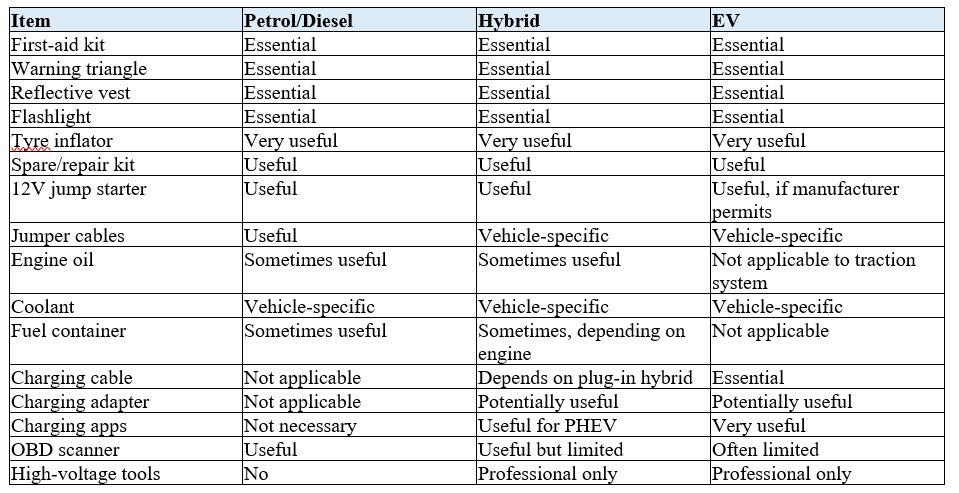
Because vehicle types differ, it helps to compare what's essential, useful, or professional-only across each category:
The Ideal Beginner's Car Emergency Kit
If a first-time owner asked, “I just bought my first car — what should I actually put in it?”, the answer isn't to fill the boot with fifty gadgets. A sensible starting point looks like this:
Safety
• Warning triangle
• Reflective vest
• First-aid kit
• Flashlight/headlamp
• Emergency blanket
• Gloves
Tyres
• Spare wheel or manufacturer-approved repair kit
• Jack
• Wheel wrench
• Tyre-pressure gauge
• Portable compressor
Electrical
• Appropriate 12V jump starter
• Phone charger
• Power bank
• Charging cable
Basic Tools
• Small tool kit
• Pliers
• Screwdrivers
• Electrical tape
• Cable ties
Personal Emergency Supplies
• Drinking water
• Non-perishable snacks
• Wet wipes/tissues
Vehicle Information
• Owner's manual
• Insurance/recovery information
• Emergency contacts
From there, it's worth adding vehicle-specific equipment. For an EV: a charging cable, an appropriate adapter, knowledge of charging locations, and knowledge of the manufacturer's 12V emergency procedure. For a petrol or diesel vehicle: the correct engine oil if appropriate, knowledge of the spare tyre and jacking system, and a basic jump-start procedure. For a hybrid: treat the 12V system as potentially serviceable only according to the manufacturer's instructions, and treat the high-voltage system as professional-only.
What to Check When Buying a Car: An Inspection Guide.
The Most Important Lesson About Your Car Emergency Kit
The key lesson for a new driver is that the best emergency equipment isn't the equipment you own — it's the equipment you know how to use safely. A tyre inflator you understand, a warning triangle you can deploy quickly, a working flashlight, and a charged phone are more valuable than a boot full of tools you don't know how to use. Build your car emergency kit around your actual vehicle, your actual journeys, and the skills you actually have, and it will serve you far better than a kit assembled purely from a checklist.