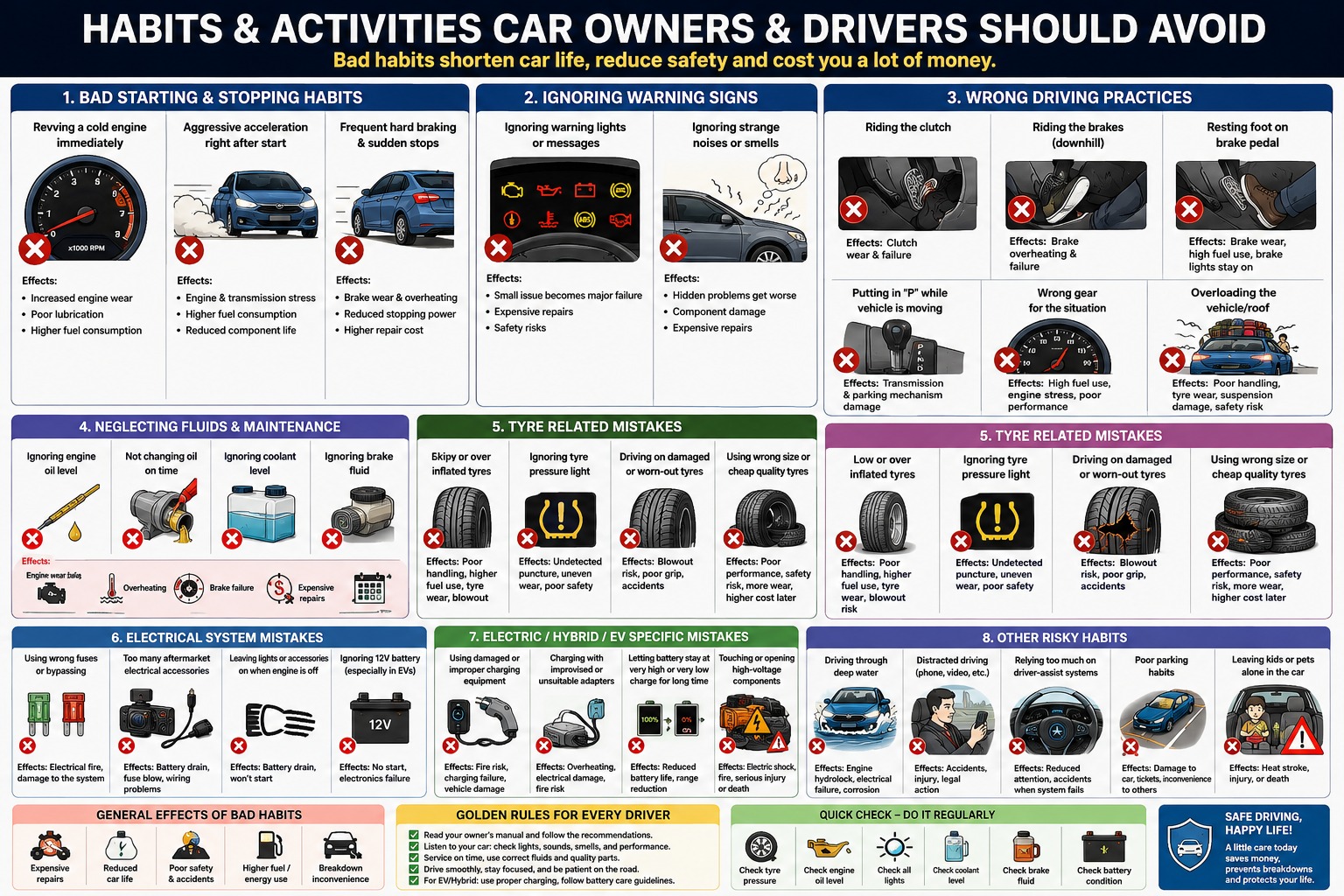
Many expensive car problems don't begin with a major mechanical failure. They often begin with small habits that are repeated for months or years. This guide walks through the car habits to avoid if you don't want to damage your vehicle, waste money, or put yourself and other people at risk, organised into categories so you understand not only what to avoid, but why it matters, and whether it applies to petrol/diesel cars, hybrids, EVs, or all vehicles.
Bad Starting and Stopping Habits
Don't start a petrol or diesel engine and immediately accelerate aggressively to high RPM. When the engine is cold, the oil hasn't yet reached its normal operating condition throughout the engine, which can mean increased engine wear, increased fuel consumption, poor lubrication during the first moments of operation, and greater mechanical stress. You don't need to sit idling for 15–20 minutes either — start the vehicle, allow the systems to stabilise briefly, then drive gently until it warms up. For an EV, this particular engine-warm-up issue doesn't apply because there is no conventional combustion engine, although the battery and other systems still have temperature-management requirements.
Similarly, avoid repeatedly revving the engine while stationary, since there is usually little benefit and it causes unnecessary fuel consumption, engine noise and wear, increased emissions, and unnecessary stress on mechanical components. And even if the engine sounds normal, cold oil and cold mechanical components aren't at their ideal operating condition, so drive gently during the first part of any journey.
Never Ignore What the Car Is Telling You
Driving With Warning Lights On
One of the most expensive habits is thinking “the car still drives, so I'll deal with the warning light later.” That's dangerous. Warning lights can indicate anything from a minor issue to a potentially catastrophic failure, including oil-pressure warnings, engine temperature warnings, brake warnings, battery/charging warnings, the check-engine light, ABS warnings, airbag warnings, tyre-pressure warnings, transmission warnings, EV system warnings, and high-voltage system warnings. A red warning light generally deserves immediate attention — if the oil-pressure warning comes on while driving, continuing to drive could cause severe engine damage, and if the temperature warning indicates overheating, continuing to drive can cause major engine damage. The rule is simple: don't simply clear a warning light without finding out why it appeared.
Ignoring Strange Sounds
A car communicates through sounds, and a new grinding, knocking, clicking, squealing, humming, whining, rattling or clunking noise can be an early warning. Grinding while braking may indicate severe brake-pad wear or another brake problem. Clicking while turning can indicate a driveline or CV-joint issue. Knocking from the engine can indicate a serious mechanical problem. High-pitched belt noise can indicate a belt, pulley or tensioner problem. And unusual EV motor or bearing noise may also warrant inspection. Don't wait until the noise becomes unbearable.
Ignoring Smells
Unusual smells are another warning system. A burning oil smell suggests a possible oil leak or oil contacting hot components. Burning rubber could indicate belt problems, tyre contact, or overheating components. A burning electrical or plastic smell could indicate an electrical problem. A fuel smell is a potentially serious fuel-system leak. A sweet smell may indicate coolant leakage. And for EVs and hybrids, if you notice unusual smoke, heat, chemical smells, or other signs of battery damage, don't investigate a high-voltage system yourself — move away if necessary and seek professional assistance.
Ignoring Overheating
For petrol and diesel cars, overheating can cause extremely expensive damage, including head-gasket failure, a warped cylinder head, engine seizure, or damage to cooling-system components. If the temperature warning appears or the temperature gauge moves into a dangerous range, stop safely and investigate according to the manufacturer's instructions. Don't immediately remove a hot radiator or coolant cap, since a pressurised cooling system can release extremely hot coolant or steam.
Water and Flood Hazards
Don't drive through deep water casually — this applies to petrol, diesel, hybrid and EV vehicles alike. Water can damage the engine, transmission, electrical components, sensors, wheel bearings, brakes, and high-voltage components. A vehicle's advertised water-wading capability doesn't mean it can safely drive through any flood, floodwater depth can be difficult to judge, and the road underneath may be damaged. If you don't know how deep the water is, don't enter it.
Never assume an EV is automatically safe in floodwater either. EVs are designed with significant protection against water exposure, but that doesn't mean every flooded EV is safe to drive. A submerged or seriously water-damaged EV or hybrid should be professionally assessed — don't open battery compartments or attempt to inspect high-voltage components yourself.
Braking Habits That Cause Damage
A common beginner habit is continuously holding the brake pedal while descending a long hill, which can cause excessive brake heat, brake fade, reduced braking performance, premature brake wear, and overheated brake components. Instead, use appropriate lower gearing where available. Many EVs and hybrids can use regenerative braking, which helps slow the vehicle while recovering energy, but regenerative braking doesn't mean the friction brakes never matter.
It's also worth being careful about resting your foot on the brake pedal, since some drivers lightly press it without realising it, which can keep brake lights illuminated, create unnecessary brake drag, increase brake wear, and generate heat. Keep your foot away from the brake unless you're actually braking.
Transmission and Gear-Selector Habits
On a manual car, resting your hand on the gear lever can place unnecessary pressure on transmission components depending on the design and driving habits, and more importantly it encourages poor driving posture and can interfere with proper control — use the gear selector when you need it. Don't ride the clutch either: “riding the clutch” means keeping your foot partially on the clutch pedal while driving, which can cause clutch slipping, excessive clutch wear, heat, and premature clutch replacement, and a clutch replacement can be expensive, so once you've completed a gear change, remove your foot from the clutch pedal.
Avoid using the clutch to hold the vehicle on a hill, too — some manual drivers partially engage the clutch and accelerator to prevent rolling backward, which can burn the clutch. Use the parking brake, the brake pedal, or a proper hill-start technique instead.
On an automatic, don't shift incorrectly: don't move between D and R, or R and D, while the vehicle is still moving significantly — come to a complete stop before changing direction, since repeatedly doing otherwise can stress the transmission and driveline. Don't put an automatic transmission into Park while moving either, since the parking mechanism is designed to hold a stationary vehicle, and engaging it while moving can cause severe mechanical stress or damage. And don't use Park instead of the parking brake: when parking on an incline especially, use the parking brake as intended, since the transmission's parking mechanism isn't supposed to be the only thing holding the entire vehicle's weight.
Overloading and Towing Mistakes
Every vehicle has limits for passenger weight, cargo weight, roof load, and towing weight, and exceeding them can affect braking, steering, suspension, tyres, fuel economy, EV range, and stability, so check the manufacturer's specifications. Roof racks have their own weight limits too — an excessively heavy roof load raises the vehicle's centre of gravity, can affect handling, and increases aerodynamic drag, raising fuel consumption or EV energy consumption. Never assume “the car is big, so it can tow anything” — check the maximum trailer weight, maximum tongue or nose weight, trailer-braking requirements, hitch rating, transmission requirements, cooling requirements, and any EV towing limitations, since towing can also dramatically reduce EV range.
Tyre and Alignment Neglect
Ignoring tyre pressure is one of the simplest maintenance tasks and one of the most commonly neglected. Incorrect pressure affects safety, braking, steering, tyre life, fuel economy, and EV range, so check tyres regularly when they're cold, and use the manufacturer's recommended pressure rather than the maximum pressure printed on the tyre sidewall. Don't continue driving normally on a tyre with bulges, deep cuts, exposed cords, severe cracking, a significant puncture, or sidewall damage — a tyre failure at highway speed can be extremely dangerous. Don't choose tyres simply because they're cheaper, either; tyres are one of the most important safety components, so consider correct size, load rating, speed rating, appropriate design, weather conditions, and vehicle requirements, and remember that for EVs, tyre selection can also affect range and noise.
If the car pulls to one side, the steering wheel isn't centred, or the tyres wear unevenly, have the alignment checked, since poor alignment can cause rapid tyre wear, poor handling, and increased rolling resistance. And don't ignore tyre-pressure warning systems — a warning doesn't necessarily mean the sensor is broken; check the tyres, since a slow puncture can cause a warning before the tyre looks obviously flat.
Fuel and Fluid Mistakes
Never guess whether a petrol or diesel car needs petrol or diesel — check the fuel-door label and owner's manual, and if you put the wrong fuel in the vehicle, don't start the engine; contact an appropriate recovery or fuel-drain service. Repeatedly driving with extremely low fuel can also be problematic, since running out of fuel can leave you stranded in unsafe locations, and for diesel vehicles, running completely out of fuel can make restarting more complicated on some systems.
Don't ignore the engine oil level either — low oil can cause severe engine damage, so check it according to the manufacturer's instructions and use the correct specification rather than adding random oil; too little oil is dangerous, but excessive oil can also cause problems. Don't overfill engine oil under the assumption that “if a little oil is good, more must be better” — it isn't, and overfilling can cause aeration or foaming, increased crankcase pressure, oil leaks, and engine damage in some circumstances, so follow the manufacturer's specified level. Never open a hot coolant system, since a hot cooling system can be pressurised and opening it can release boiling coolant or steam — wait until the system has cooled and follow the manufacturer's instructions. And don't mix random coolants: coolant isn't simply “green liquid,” different vehicles use different coolant specifications, and mixing incompatible products can cause problems.
Neglected Routine Maintenance
A car isn't maintained by waiting for something to break. Follow the manufacturer's service schedule for engine oil, filters, brake inspection, transmission service where applicable, coolant, spark plugs, belts, suspension, steering and tyres. EVs generally have fewer conventional powertrain maintenance requirements, but they still need inspections — don't assume EVs require no maintenance at all. An EV doesn't have a conventional engine oil-change schedule, but it still has tyres, brakes, suspension, steering, a cabin filter, cooling systems, a 12V battery, wipers, air conditioning, software, and high-voltage system components, and brake fluid still needs attention according to the manufacturer's schedule.
EV Charging and Battery Habits
Don't abuse regenerative braking by treating it as a substitute for understanding the vehicle — regeneration can vary depending on battery charge, battery temperature, driving mode, road conditions, and system limits, and when the battery is very full or very cold, regenerative braking may be reduced, so learn how your particular vehicle behaves under these conditions.
Don't repeatedly fast-charge an EV without understanding the vehicle, either. DC fast charging is useful for long trips, but charging speed depends on battery temperature, battery state of charge, charger power, and vehicle charging capability, and charging often becomes slower as the battery approaches a high state of charge — for long journeys, you don't necessarily need to charge to 100% every time, so follow the manufacturer's recommendations. Don't let an EV sit at extreme battery levels unnecessarily, either: battery-management recommendations vary by manufacturer and battery chemistry, but as a general principle, avoid leaving the vehicle at extremely high or extremely low charge for long periods unless the manufacturer specifically recommends it.
Never charge with damaged equipment — don't use a charging cable that is cut, burned, cracked, exposed internally, water-damaged, or showing damaged connectors, since charging equipment carries substantial electrical power; replace damaged equipment rather than improvising a repair. And don't use improvised EV charging arrangements: never assume “the plug fits, therefore it's safe.” Charging equipment needs appropriate voltage, current capacity, grounding, protection, and connector compatibility, so avoid questionable adapters, damaged extension cables, and improvised wiring.
High-Voltage and Electrical Safety Rules
Don't touch high-voltage EV or hybrid components — this is one of the most important EV rules. Don't open high-voltage battery packs, high-voltage service covers, orange high-voltage cables, or inverter assemblies unless you are appropriately trained and equipped; the high-voltage system is not a DIY project for a first-time owner. Don't assume switching off an EV makes the high-voltage system safe, either — the vehicle being “off” does not mean you should touch high-voltage components; use the manufacturer's emergency procedure and qualified technicians for high-voltage work. And if an EV or hybrid has suffered significant collision or battery damage, don't simply park it in a garage and forget about it — follow manufacturer or emergency-service guidance, since a damaged high-voltage battery can present hazards that aren't obvious from outside the vehicle.
Don't modify electrical systems casually, either. Avoid amateur modifications to wiring, fuses, charging systems, battery connections, or high-current circuits, since installing accessories incorrectly can cause electrical faults, battery drain, overheating, fires, and computer errors. Never replace a fuse with a higher-rated fuse — if the vehicle specifies a 10A fuse, don't install a 20A fuse simply because the 10A keeps blowing, since the fuse protects the circuit and a repeatedly blown fuse means there may be an underlying electrical problem. And never permanently disable or bypass airbags, seat-belt systems, ABS, stability control, collision-warning systems, or driver-assistance safety systems — these systems exist for a reason.
Driver-Assistance and Attention Mistakes
Don't blindly trust driver-assistance systems, particularly on modern cars. Features such as lane-keeping assistance, adaptive cruise control, automatic emergency braking, blind-spot monitoring, traffic-sign recognition, parking assistance, and highway assistance are driver assistance, not permission to stop paying attention — technology can misread road markings, fail to detect objects, be affected by weather, be confused by unusual road layouts, and have sensor limitations, so keep your attention on driving. Don't treat “autopilot” as a human replacement, whatever name a manufacturer uses — driver assistance is not the same as autonomous driving, and the driver remains responsible according to the vehicle's operating instructions and applicable law.
Don't drive distracted: avoid texting, holding your phone, watching videos, adjusting complicated settings while moving, eating in a way that interferes with control, or looking away for extended periods, since a vehicle can travel a significant distance in just a few seconds. Don't drive when excessively tired, either, since fatigue can seriously reduce reaction time, attention, decision-making, and hazard perception — if you're too tired to drive safely, stop and rest. And don't drive aggressively: aggressive acceleration, hard braking, and rapid cornering increase fuel consumption, EV energy consumption, tyre wear, brake wear, mechanical stress, and accident risk, since smooth driving is generally better for both the car and the occupants.
Road Hazards and Suspension Neglect
Don't accelerate hard over potholes — they can damage tyres, wheels, suspension, and steering components, so if you see one and it's safe to do so, slow down before reaching it, and don't suddenly swerve into another lane to avoid it. Don't ignore suspension symptoms either: if the vehicle bounces excessively, clunks over bumps, pulls to one side, sits unevenly, or produces unusual tyre wear, have it inspected, since suspension problems can affect handling and braking. And don't park with the wheels violently turned for long periods unnecessarily — modern power steering systems are more tolerant than older systems, but there's still no benefit in holding steering components at their extreme limit unnecessarily, so avoid maintaining extreme steering lock while stationary.
More Brake, Cleaning, and Accessory Mistakes
Don't ignore brake fluid and brake problems — warning signs include a soft or spongy pedal, grinding, pulling while braking, vibration, a brake warning light, unusual noise, and increased stopping distance; brakes aren't something to postpone. Don't wash the engine bay carelessly either: modern engine compartments contain sensors, electrical connectors, control modules, alternators, fuses, and other electronic components, and high-pressure water in the wrong places can cause problems, so follow manufacturer recommendations and avoid forcing water into sensitive components. And don't use cheap electrical accessories without considering quality — cheap chargers, USB adapters, inverters, dashcam wiring, and LED modifications can cause electrical problems if poorly designed, so electrical accessories should be properly rated and installed.
Parking and Cabin Safety Habits
Don't leave valuables visible — phones, laptops, bags, cash, and documents shouldn't be visible inside a parked vehicle. Don't park in unsafe places simply because it's convenient, either: avoid blocking emergency exits, fire lanes, driveways, pedestrian paths, or other vehicles, and for EVs, don't treat a charging bay as an ordinary parking space when you're not charging. Never leave children or pets unattended in a vehicle — interior temperatures can become dangerous very quickly, even when the outside temperature doesn't seem extreme, so never treat the vehicle as a safe place to leave a child or pet unattended.
Don't place loose heavy objects inside the cabin, since in a collision, objects can become projectiles — secure tools, bottles, luggage, equipment, shopping, and heavy electronics using the boot or trunk and cargo restraints appropriately. And don't install accessories that interfere with airbags: avoid placing objects where airbags deploy, and don't attach accessories to airbag covers, steering-wheel airbag areas, dashboard airbag zones, or A-pillars where curtain airbags may deploy — an accessory that looks harmless can become dangerous during a crash.
Child Seats, Visibility, and Sensor Care
Don't install child seats incorrectly — for parents, this is one of the most important things to get right. Use the vehicle and child-seat manufacturer's instructions, and check the correct seat type, correct position, correct anchorage, correct belt routing, proper tightening, and the child's size or weight requirements. Don't assume that because the seat looks secure, it is correctly installed.
Don't neglect your windshield and wipers, since visibility is a safety system — avoid driving with a severely cracked windshield, worn wiper blades, dirty glass, poor washer fluid, or obstructed cameras or sensors, since modern driver-assistance systems may also depend on cameras located around the windshield area. Don't cover or dirty sensors and cameras either: modern vehicles may have sensors or cameras in the front grille, bumpers, windshield, mirrors, rear bumper, and roof, and mud, snow, dirt or aftermarket accessories can interfere with them — if an ADAS warning appears, check the manufacturer's instructions. And don't put random stickers over cameras or sensors: a sticker may look harmless but can interfere with cameras, radar, parking sensors, and driver-assistance systems, so know what a component does before covering it.
Diagnostics, Parts, and Who Works on the Car
Don't reset warning lights without diagnosing the problem — an inexpensive diagnostic scanner can clear some codes, but clearing a code doesn't repair the vehicle; it's like turning off a smoke alarm without finding the fire, so if the warning returns, investigate the cause. Don't buy parts solely because they're the cheapest, either, since the cheapest component isn't necessarily the cheapest solution — a poor-quality brake pad, tyre, sensor, battery, filter, or suspension component can cause additional problems, so use reputable parts appropriate for the vehicle. And don't let unqualified people work on safety-critical systems — be particularly careful with brakes, steering, airbags, high-voltage systems, fuel systems, suspension, and ADAS calibration, since saving a small amount on labour isn't worth creating a safety problem.
Software Updates and Vehicle Modifications
Don't ignore software updates — modern cars increasingly depend on software, and updates can address bugs, charging behaviour, infotainment problems, driver-assistance improvements, security issues, and vehicle-system problems, so follow manufacturer instructions for software updates and don't install unofficial software simply because someone online says it will make the vehicle faster or unlock features. Don't modify the vehicle without understanding the consequences, either — examples include larger wheels, lower suspension, engine tuning, aftermarket exhausts, electrical modifications, non-standard lights, and heavy accessories, and modifications can affect reliability, insurance, warranty, fuel consumption, EV range, handling, safety, and legal compliance.
12V Battery Neglect
Don't neglect the 12V battery — this applies to EVs, hybrids and conventional cars alike. A 12V battery can fail even when the main vehicle appears otherwise healthy, so watch for slow starting, flickering electronics, strange electrical behaviour, repeated battery warnings, and difficulty unlocking or starting the vehicle. For EVs and hybrids, remember that the 12V battery is separate from the high-voltage traction battery.
Don't disconnect a battery casually, either. Before disconnecting a modern vehicle's 12V battery, check the manufacturer's procedure, since you may reset windows, the clock, the radio, memory settings, control modules, and learned parameters, and some vehicles require battery registration or calibration after replacement. Never attempt to disconnect the high-voltage battery yourself unless you are appropriately trained.
The Biggest Lesson: Don't Wait Until the Car Breaks Down
This is perhaps the biggest lesson for a first-time owner, and it ties together nearly every one of the car habits to avoid discussed above. There are two types of maintenance: preventive maintenance and reactive repair. Preventive maintenance might cost you some money today. Reactive repair can cost considerably more after a component fails.
A Simple Framework to Remember Everything: WATCH and DRIVE
A new driver can remember most of these car habits to avoid using two simple frameworks.
WATCH
• W — Warning lights and unusual messages: never ignore serious warnings
• A — Air, tyres and fluids: check tyre pressure and important fluid levels
• T — Temperature: watch for overheating and abnormal heat
• C — Changes: notice new sounds, smells, vibrations or handling changes
• H — High-voltage safety: for hybrids and EVs, never casually touch high-voltage components
DRIVE
• D — Don't drive aggressively when unnecessary
• R — Respect warning signs
• I — Inspect tyres and lights
• V — Verify fluids, charging and fuel
• E — Expect maintenance
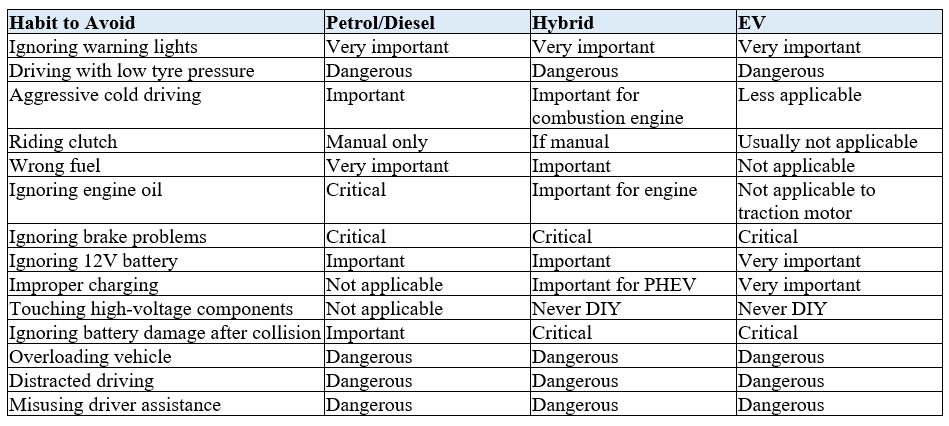
The Biggest Mistakes by Vehicle Type
Five Rules Every New Car Owner Should Remember
• If the car suddenly behaves differently, investigate it. Don't wait for a small problem to become a major failure.
• Never ignore red warning lights, overheating, brake problems, fuel leaks, smoke, or unusual electrical behaviour.
• Look after the things connecting the car to the road: tyres, brakes, steering and suspension.
• EVs and hybrids require an additional level of electrical awareness. The 12V system is not the same as the high-voltage traction system, and you should never improvise high-voltage repairs.
• The owner's manual is part of the car. It tells you what fluids, pressures, charging procedures, towing methods, maintenance intervals and emergency procedures are appropriate for that particular vehicle.
Read more on: What to Check When Buying a Car: An Inspection Guide
Final Thoughts on the Car Habits to Avoid
A good car owner isn't someone who knows how to repair every component. It's someone who recognises problems early, avoids damaging habits, performs the maintenance they can safely perform, and knows when to stop experimenting and call a qualified professional. Learning these car habits to avoid now is far cheaper than learning them after an expensive repair bill.