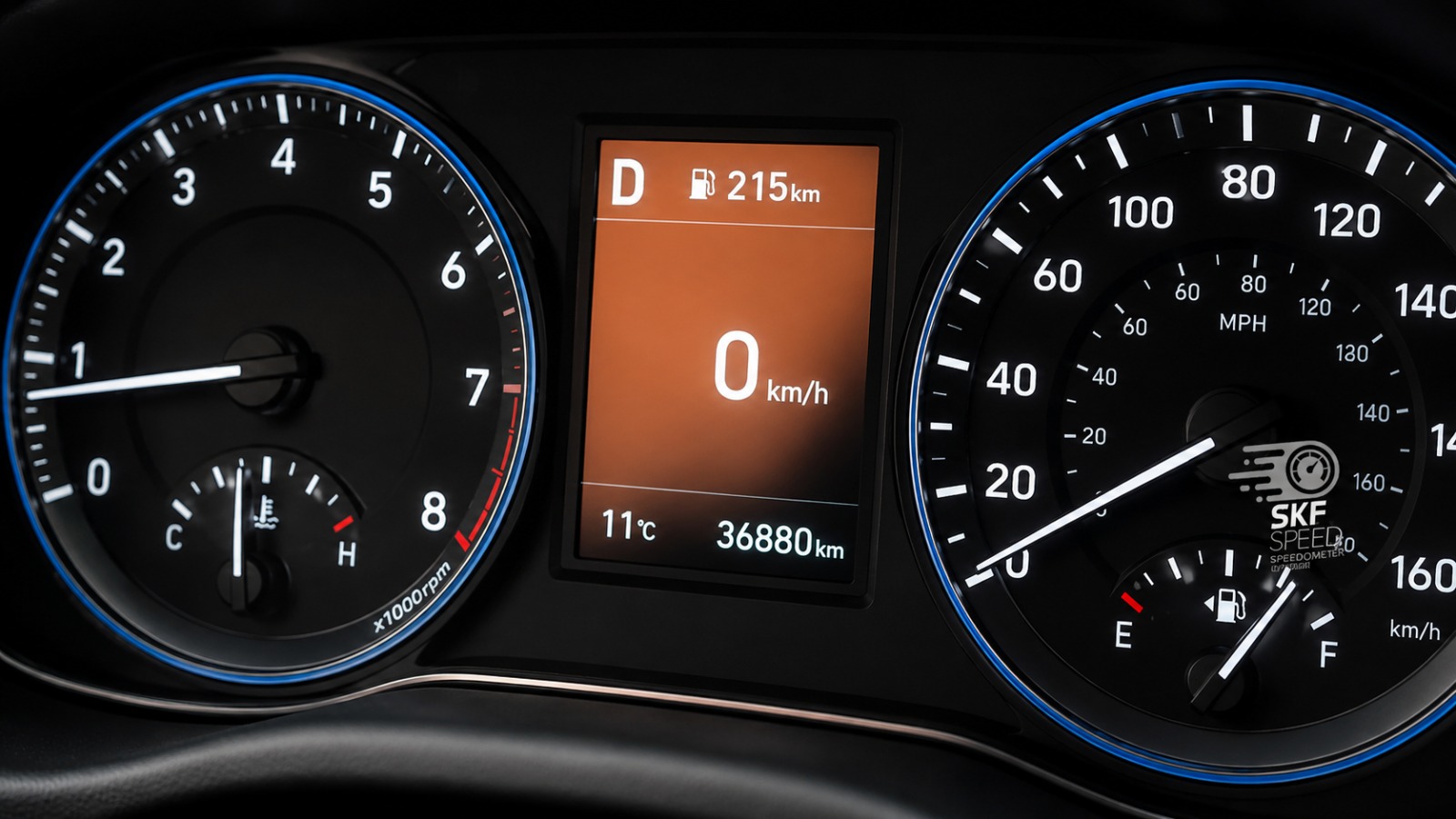
If a mechanic set out to confirm whether the mileage on your car's odometer is genuine, they would never simply glance at the number on the dashboard. Instead, a skilled technician tries to establish whether the mileage is consistent across multiple independent sources. It is worth being upfront about one thing: there is no single test that can prove mileage is genuine on every car. Modern odometers can sometimes be altered in ways that leave little obvious evidence, so the strongest approach is to compare several records and electronic modules rather than rely on any one of them alone. Here, step by step, is exactly how to confirm your car's mileage the way a professional would.
Understanding What the Odometer Actually Tells You
Suppose your dashboard reads 87,450 km. That number is simply the car's displayed odometer reading — it does not automatically prove that the car has travelled only that distance. Depending on the vehicle, mileage-related information may also exist in the engine control module (ECU), the transmission control module, the ABS module, the body control module, the instrument cluster, and on some vehicles even the key or fob memory. It can also appear in service records, inspection records, dealer records, imported auction records, and previous registration or inspection documents. However, not every car stores mileage in all of these places, so the first step is always to identify the exact vehicle you are dealing with.
How to Confirm Your Car's Mileage Step by Step
Start With a Reference Point
Before doing anything else, photograph the odometer, the VIN or chassis number, the registration number, and the dashboard as a whole. For example: VIN XXXXXXXX, odometer 87,450 km, dated 18 August 2026. This matters because it creates a reference point; if a document later surfaces showing the vehicle previously had 126,000 km, that discrepancy becomes extremely important. At the same time, identify the exact car — make, model, year, engine, transmission, VIN/chassis number, and country of origin — because different manufacturers store mileage information differently.
Don't Trust a Scanner Alone
A common misconception is plugging in a cheap OBD scanner and declaring, “the ECU says 87,450 km, so the odometer is genuine.” That is not enough. Some vehicles do not store total mileage in the ECU in a way that can be independently compared, and if someone has deliberately manipulated the vehicle, they may have altered information in more than one module. Electronic scanning should be treated as one piece of evidence, not the final answer.
Dig Into Historical Records
This is one of the strongest methods available for how to confirm your car's mileage. Try to find the car's mileage at previous dates and build a simple timeline — for instance, 32,500 km in 2020, 45,200 km in 2021, 59,800 km in 2022, 74,300 km in 2023, and 91,600 km in 2024. If the current reading then shows 87,450 km, the mileage has gone backwards, which is an impossible result and a very strong indication of odometer manipulation.
For a Japanese import in particular, obtain the original auction information where available. If the current dashboard shows 87,450 km but the auction record shows 132,000 km, that is a major problem worth investigating rather than simply accepting an explanation such as “the dealer changed the meter.” Once you have the auction document, verify it against the physical vehicle itself — compare the chassis number, model, year, colour, engine, auction date, mileage, and auction details. If the chassis number on the document does not correspond to your vehicle, stop; if the seller cannot explain it, walk away.
Service records can be just as revealing. An invoice dated June 2023 showing an odometer reading of 96,400 km, when the car today shows only 87,450 km, is a major red flag, and the same logic applies to oil-change stickers, service books, dealer records, repair invoices, tyre-replacement records, and inspection documents. It is also worth physically searching the car for old mileage stickers around the door frame, windscreen, engine bay, sun visor, and glovebox — an oil-service sticker noting 105,000 km against a dashboard reading of 87,450 km is a serious inconsistency. If the vehicle has a physical maintenance or service book, examine the dates, mileage entries, workshop names, stamps, signatures, and service intervals carefully, but remember that a service book can also be falsified. The strongest evidence is always when multiple independent records agree with one another.
Scan the Vehicle Electronically
The next step moves into diagnostics proper. A professional diagnostic scanner appropriate for the specific vehicle — not just a cheap Bluetooth OBD dongle — should be used to scan every accessible module, which may include the engine ECU, transmission module, ABS, airbag/SRS, body control module, instrument cluster, and other manufacturer-specific modules, looking for mileage-related information and inconsistencies.
Scanning multiple modules matters because a dashboard reading of 87,450 km alongside a significantly higher mileage-related value found in another module does not automatically prove fraud, since different manufacturers calculate and store mileage differently, but it does give a strong reason to investigate further. The scan may also reveal diagnostic history such as stored fault codes, previous fault events, freeze-frame data, module-replacement information, and communication history; a stored fault logged at 118,000 km against a current odometer of 87,450 km is highly suspicious, though interpretation depends heavily on the specific vehicle and scan tool used.
It is also worth checking whether the instrument cluster, ECU, BCM, or other modules have been replaced, since a mileage discrepancy is not always the result of a deliberate rollback — the cluster itself may simply have been swapped, in which case there should be documentation explaining when and why. Physically examining the instrument cluster for scratched screws, damaged clips, broken trim, tool marks, misaligned dashboard panels, or other evidence of disassembly can support this line of investigation; on its own this does not prove mileage fraud, since a cluster may have been removed legitimately for repair, but combined with inconsistent mileage records it becomes far more significant.
Read the Physical Wear Clues
From here, the investigation moves to physical evidence, which should always be treated as supporting evidence rather than proof. The steering wheel experiences constant contact, so surface wear, shiny patches, peeling, cracks, and button wear are worth noting, but wear varies hugely between drivers — someone can destroy a steering wheel in 40,000 km while another keeps one looking good for 150,000 km. The driver's seat is particularly useful because the same person repeatedly enters and exits from the same spot, so check the cushion, side bolster, fabric or leather, entry and exit wear, tears, and compression, while remembering that seat condition cannot prove an exact mileage.
Likewise, inspect the pedals — accelerator, brake, and clutch on a manual — since heavy wear against a very low claimed mileage deserves a question, even if it does not automatically mean the mileage was altered. On automatics, look at the gear selector surface, buttons, and surrounding trim for consistency, and examine the driver's door handle, window switches, lock buttons, armrest, door trim, and hinge area, since this is the most-used door on the car. The driver's seatbelt webbing, buckle, fraying, dirt, and wear can offer further clues, and the tyres — brand, model, size, manufacturing date, and tread depth — are worth recording too, since a car with supposedly very low mileage but several tyre sets in its history deserves an explanation, though tyre wear also depends on age, road conditions, the driver, tyre quality, and storage.
Brake-disc wear is another clue, but avoid the common mistake of assuming thin discs automatically mean high mileage — brake wear depends heavily on driving style, traffic, terrain, vehicle weight, and brake-pad material, and a city-driven car can wear its brakes much faster than a highway-driven one. Suspension components — shock absorbers, bushings, ball joints, tie rods, wheel bearings, and CV joints — are affected by road quality just as much as distance, so a car driven 60,000 km on terrible roads can show more wear than one driven 150,000 km on smooth highways. Finally, the engine's overall condition — oil leaks, hoses, belts, seals, engine mounts, general cleanliness, and repairs — is worth examining, but a clean engine bay does not mean low mileage and a dirty one does not mean high mileage, since an engine bay can easily be cleaned before a sale. In every case, condition is not the same thing as exact mileage.
Run the Numbers
A car's age is a useful sanity check. A 2014 vehicle with a claimed 32,000 km is possible, but a twelve-year-old car averaging only a few thousand kilometers a year is unusual enough to deserve evidence, even though there are legitimate explanations such as the car being a second vehicle, used only occasionally, owned by an elderly driver, or stored for long periods. Calculating the implied annual mileage helps too: a 2018 car showing 48,000 km works out to roughly 6,000 km a year, which is plausible, while a 2012 car showing 28,000 km works out to roughly 2,000 km a year, which is possible but would call for stronger documentation.
Checking the mileage progression over time is one of the most effective methods of all. A timeline moving steadily from 22,000 km in 2019 up to 87,000 km in 2026 looks entirely plausible. On the other hand, a timeline that climbs from 65,000 km in 2019 to 104,000 km in 2022 and then suddenly drops to 76,000 km in 2023 is a huge red flag, because mileage should never decrease. Above all, never trust a single piece of evidence in isolation. If the dashboard shows 85,000 km, the auction record shows 84,000 km, the service history shows 86,000 km, the diagnostic history is consistent, and the interior and tyres match the claimed usage, that combination is strong evidence of a genuine reading. But if the dashboard shows 85,000 km while the auction record shows 132,000 km, a service invoice shows 126,000 km, and the diagnostic data is inconsistent, it is reasonable to assume there is a serious mileage problem unless a documented explanation is provided.
Understand “Mileage Correction” and Be Wary of Cheap Tools
If a seller says the mileage was “corrected,” that phrase should immediately prompt the question “why?” There are legitimate situations in which an instrument cluster is replaced or repaired, but “correction” can also be a euphemism for an outright rollback, so ask for documentation explaining why it was changed, what the old mileage was, what the replacement cluster showed, and when the work happened. Similarly, be careful with cheap OBD devices — they are useful for many things, but they are not reliable enough to answer the question of whether an odometer has been rolled back, since many simply read generic diagnostic information. For a genuine mileage investigation, a technician with a professional tool capable of accessing the manufacturer's relevant modules is worth far more than an inexpensive Bluetooth dongle. And if someone claims “the computer shows the same mileage,” always ask which computer, since a modern car may have several electronic control modules, and without knowing which module was scanned, what value was found, what that value represents, and whether the manufacturer normally stores mileage there, the number on a scanner is not very meaningful on its own.
Read more on What to Check When Buying a Car: An Inspection Guide
How to Confirm Your Car's Mileage With a Full Evidence File
The most reliable approach is to build a complete mileage evidence file rather than relying on any single check. That file should combine:
• Current evidence: a dashboard photo and a VIN/chassis photo
• Import history: the auction sheet, export documents, and inspection records
• Maintenance history: the service book, invoices, oil-change stickers, and repair records
• Electronic evidence: a diagnostic scan, module information, and fault history where available
• Physical evidence: the steering wheel, driver's seat, pedals, gear selector, door controls, tyres, and brake/suspension condition
Once everything is gathered, compare it and classify the result. High confidence looks like an auction record of 73,000 km, an export record of 73,000 km, a service record of 75,000 km, a current reading of 82,000 km, and diagnostics and physical wear that are both consistent — in that case, reasonable confidence in the mileage is justified. An uncertain result looks like an auction record of 80,000 km against a current reading of 87,000 km with no service history and no diagnostic mileage information available; in that situation, the honest conclusion is that the mileage cannot be proven genuine, but there is also no evidence it was altered, which is very different from declaring it definitely genuine. A high-risk result looks like an auction record of 128,000 km against a current reading of 81,000 km, or a service invoice showing 115,000 km against a current reading of 82,000 km — either combination is strong evidence of a mileage discrepancy.
The biggest mistake to avoid is assuming that condition alone can confirm mileage — statements such as “the interior looks like 80,000 km, so the mileage must be 80,000 km” or “the engine sounds good, so the mileage is genuine” are impossible to establish accurately, because a beautifully maintained 200,000 km car can sound excellent, while a neglected 60,000 km car can sound terrible. Mileage and mechanical condition are separate questions, and confusing the two undermines the entire investigation. Ultimately, the goal is to answer three separate questions: what mileage does the car currently display, what mileage did the car have previously, and is there evidence that the displayed mileage was changed? Answering all three, using independent sources, is the actual investigation.
Final Thoughts on How to Confirm Your Car's Mileage
The core principle behind how to confirm your car's mileage is simple to state, even if the investigation itself takes effort: don't try to “read” the mileage from the car — reconstruct the car's mileage history from multiple independent sources. The strongest combination is VIN/chassis history, foreign auction or inspection records, service records, a diagnostic scan, module data where applicable, and a physical wear inspection. When all of those sources tell the same story, you can have far greater confidence that the odometer has not been altered. Because electronic mileage-storage methods differ significantly between manufacturers such as Toyota, Mazda, Nissan, Subaru, Honda, Mercedes, and BMW, the exact checks that apply best will always depend on the specific make, model, year, engine, and country of origin of the vehicle in front of you.