The Benz Patent-Motorwagen: The Complete Story of the World's First Automobile
If an amateur asked which machine deserves credit for starting the automobile age, most historians would immediately point to the Benz Patent-Motorwagen. It doesn't look anything like a modern car, and yet it established the basic idea of a purpose-built, gasoline-powered automobile that the entire industry eventually grew from. In this guide, we walk through who built it, how it worked, why it mattered, and how far the automobile has traveled since 1886.
What Is the Patent-Motorwagen?
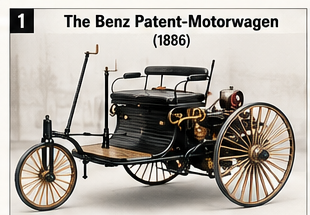
The Benz Patent-Motorwagen, created by German engineer Karl Benz, is generally regarded as the world's first practical automobile powered by an internal-combustion engine. It was patented on January 29, 1886, under German Patent No. 37435 — one of the foundational documents in automotive history. Importantly, Benz did not simply bolt an engine onto an existing horse carriage. Instead, he designed a vehicle around the engine itself, building many of the systems needed to make it operate as a genuine self-propelled road machine. That distinction is exactly why this early car occupies such an important place in automotive history.
Karl Benz: The Engineer Behind the First Car
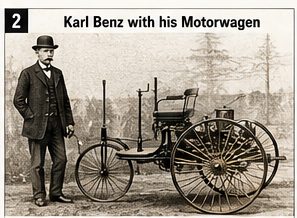
The man behind the invention was Karl Benz (1844–1929), a German engineer and inventor from Karlsruhe. He became fascinated with mechanical engineering early on and eventually built his own engineering business. His idea, at its core, was simple: instead of relying on horses, build a machine that could carry people using its own mechanical power. However, turning that idea into a working vehicle required solving numerous engineering problems at once, including the engine, fuel delivery, ignition, cooling, lubrication, steering, transmission, wheels, braking, chassis design, weight balance, and starting. In other words, Benz was not merely building an engine — he was attempting to build a complete automobile system.
What the First Automobile Actually Looked Like
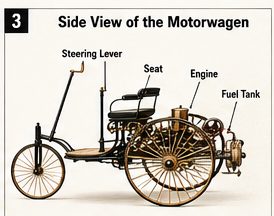
This is where modern readers are usually surprised. The vehicle did not look anything like a modern automobile; instead, it resembled a lightweight three-wheeled carriage with an engine attached. It featured three wheels, a tubular steel frame, wooden-spoked wheels, a small bench seat, a rear-mounted engine, and a long steering lever, along with exposed mechanical components. There was no enclosed cabin, no windshield, no doors, no modern dashboard, and no conventional steering wheel. Nevertheless, beneath that primitive appearance sat an extraordinarily important concept: a machine designed to move without an animal pulling it.
Why the Vehicle Had Three Wheels Instead of Four
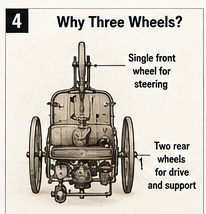
A common question is why Benz didn't simply build four wheels from the start. In truth, there were several engineering considerations behind the choice. Benz wanted the vehicle to stay lightweight and mechanically simple, so a three-wheel layout let him use two large driven wheels at the rear and a single steering wheel at the front, controlled through a basic steering mechanism. This arrangement also avoided many of the complications involved in steering two front wheels at once.
The Stability Trade-Off
On the other hand, three wheels came with a major disadvantage: stability. Modern cars use four wheels because four-point contact provides far better stability, whereas the early Motorwagen was considerably narrower and less stable by comparison.
Inside the Engine of the First Gasoline-Powered Automobile
The Single-Cylinder Powerhouse
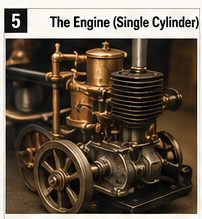
Arguably the most fascinating part of the vehicle was its engine. It used a single-cylinder, four-stroke gasoline engine that, despite its small size, was genuinely revolutionary for its time. Depending on the version, output was roughly 0.75 horsepower in the earliest model, with later versions becoming more powerful. For comparison, a modern economy car might produce 100 to 150 horsepower, meaning the first Benz had less power than many modern lawnmowers. Even so, horsepower alone doesn't tell the whole story; the real achievement was fitting a compact internal-combustion engine into a working road vehicle at all.
How the Four-Stroke Cycle Worked
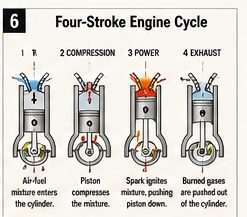
The engine operated on the basic four-stroke principle: intake, compression, power, and exhaust. During intake, the engine draws in an air-fuel mixture; during compression, the piston compresses it; ignition then produces combustion, creating expanding gases that push the piston downward; and finally, the exhaust stroke removes the burned gases before the cycle repeats. Remarkably, this basic operating cycle is still fundamental to gasoline engines more than a century later. The original engine displacement was approximately 954 cc, which is notable given that it produced only about three-quarters of a horsepower — a gap explained by more than a century of advances in metallurgy, fuel injection, combustion control, compression ratios, electronic ignition, turbocharging, and computer-controlled engine management.
Starting, Fueling, and Running the Machine
No Push-Button Start
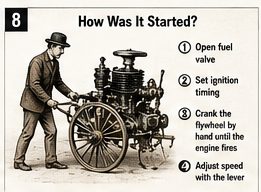
Modern drivers take a lot for granted: get in, press a button, and the engine starts. By contrast, the Patent-Motorwagen had no electric starter motor and no ignition key in the modern sense. Starting and operating it required considerably more mechanical involvement, and the driver genuinely had to understand the machine — an experience closer to operating early mechanical apparatus than driving a modern car.
A Fuel System Without Fuel Injection
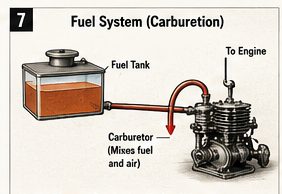
The vehicle ran on petroleum-based fuel, and its fuel system was extremely primitive compared with today's setups. There was no electronic fuel injection, no high-pressure fuel rail, no electronic control unit, and no computerized fuel management. Instead, Benz developed a basic carburetion and fuel-vaporization arrangement to provide the engine with a combustible mixture. Interestingly, fuel wasn't always bought the way we buy it today — because petrol stations didn't exist in 1886, fuel was sometimes obtained from pharmacies, where a petroleum-based cleaning solvent called ligroin was sold. This detail becomes especially important in the story of Bertha Benz, covered below.
Power, Steering, and Brakes
Mechanical Power Transmission
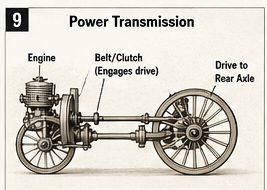
The Motorwagen had no modern multi-speed automatic or manual transmission. Its powertrain was extremely simple: the engine transmitted power mechanically straight to the rear wheels, with no 6-speed automatic, CVT, dual-clutch transmission, or electronic transmission control involved. The drivetrain was essentially a direct mechanical system built around the small engine's limited capability.
Steering With a Lever, Not a Wheel
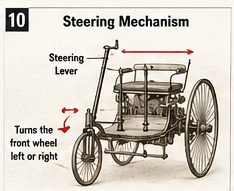
One of the most visually distinctive features was the steering system. Rather than a circular steering wheel, the driver used a steering lever; moving the lever changed the direction of the front wheel. Although this setup was very different from modern rack-and-pinion steering, the underlying principle was the same — the driver controls the vehicle's direction by mechanically changing the orientation of the front wheel.
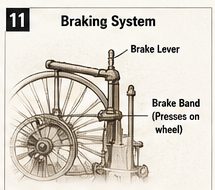
Braking was also extremely basic: the driver operated a mechanical brake acting on the wheels, with no hydraulic disc brakes, ABS, brake boosters, electronic brake distribution, or regenerative braking. As a result, braking performance was limited — a problem that became especially apparent during Bertha Benz's long-distance journey.
Cooling, Wheels, and What Modern Safety It Lacked
Keeping the Engine Cool
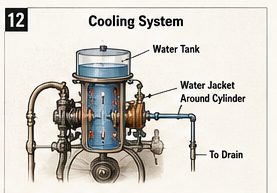
The engine still needed to shed heat, so Benz used a relatively simple water-cooling system rather than a modern pressurized radiator. Basic as it was, this arrangement demonstrated an important engineering principle that still applies today: an internal-combustion engine needs controlled temperature management to run reliably.
Wooden Wheels and Solid Tires
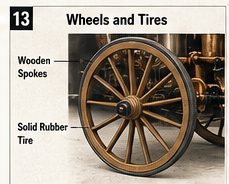
The vehicle rolled on large wooden-spoked wheels fitted with a solid rubber-type tire arrangement — a world away from modern radial pneumatic tires built with steel belts, synthetic rubber, computer-designed tread patterns, and sophisticated sidewall construction.
No Windshield, No Seat Belts, No Airbags
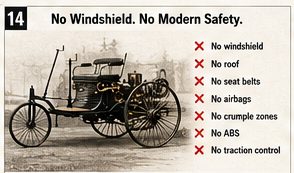
Picture driving at 16 km/h with no windshield, no roof, no air conditioning, no wipers, no airbags, and no seat belts. If it rained, you got wet; if there was dust, you breathed it; if an insect hit you, you certainly felt it. In many ways, early automobiles were closer to motorized open carriages than to modern passenger vehicles, and safety equipment such as crumple zones, ABS, traction control, and collision-avoidance systems simply didn't exist yet — not because engineers overlooked them, but because the priority at the time was making the automobile move reliably at all.
Bertha Benz: The Journey That Proved the Automobile Worked
Who Was Bertha Benz?
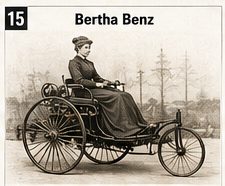
No account of the Benz Patent-Motorwagen would be complete without Bertha Benz. She was Karl Benz's wife and a pivotal figure in the automobile's development — because while Karl invented the machine, it was Bertha who helped prove it could actually be used for meaningful transportation.
The 106-Kilometre Road Trip
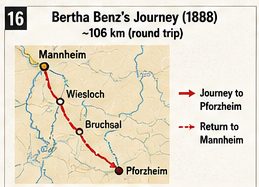
In 1888, without waiting for Karl's permission, Bertha took one of the vehicles on a remarkable journey with her sons Eugen and Richard, traveling roughly 106 km (about 66 miles) from Mannheim to Pforzheim and back. This trip is widely regarded as the first long-distance automobile journey in history, and it functioned as a real-world engineering test rather than a simple joyride.
Roadside Repairs That Shaped Automotive Engineering
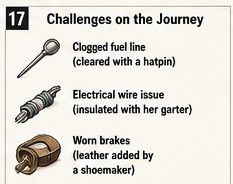
Along the way, Bertha encountered problems and improvised solutions on the spot. She reportedly used a hatpin to clear a blocked fuel line, a garter to insulate a damaged electrical wire, her sons' muscle when the vehicle needed a push, and a shoemaker's services to repair worn brake components by adding leather to the brake shoes. In effect, this was an early example of real-world feedback directly influencing automobile design, and it demonstrated that the automobile could handle practical transportation over a significant distance — a very different achievement from an invention sitting untested inside a workshop.
How Fast Was the First Car, Really?
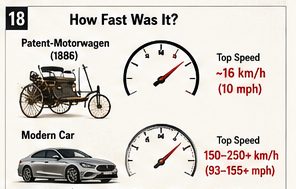
Expectations need adjusting here too. The earliest Motorwagen had a top speed of roughly 16 km/h (10 mph), while later versions became somewhat faster. For comparison, modern highway speeds typically range from 80–130 km/h depending on the country, modern performance cars exceed 250 km/h, and Formula 1 cars can top 300 km/h. At just 16 km/h, a modern cyclist could plausibly keep pace with it for short stretches. Still, in 1886 that speed was extraordinary simply because the vehicle achieved it under its own mechanical power, without a horse in sight.
Before Benz: Earlier Attempts at Self-Propelled Vehicles
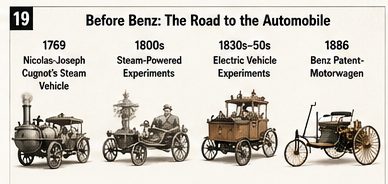
It's tempting to say Karl Benz invented the automobile, and broadly that's correct, but historically it needs a qualification. People had been experimenting with self-propelled vehicles for centuries before him. Nicolas-Joseph Cugnot, for example, built a steam-powered vehicle in France back in the 18th century, and various other experiments involving steam engines, electric propulsion, and early internal combustion had already taken place. So Benz did not invent the general concept of a self-propelled road vehicle; rather, his achievement was creating one of the first practical, purpose-built gasoline-powered automobiles.
From Benz's Workshop to the Mercedes-Benz Badge
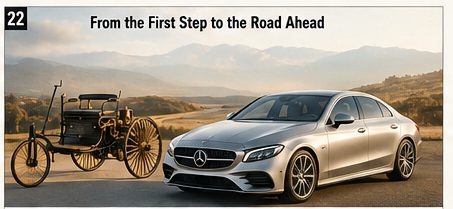
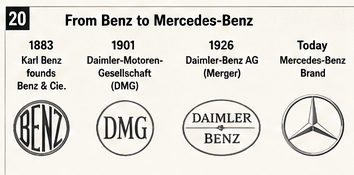
This is where the story connects directly to a brand people still recognize today. Karl Benz's company eventually became part of the corporate history that led to Mercedes-Benz, after merging with Gottlieb Daimler and Wilhelm Maybach's company in 1926 to form Daimler-Benz AG. Consequently, when you look at a modern Mercedes-Benz today, there is a direct historical line running back to Benz's three-wheeled machine from the 1880s — and, remarkably, the descendants of that machine eventually produced everything from 300 km/h supercars and electric vehicles to luxury limousines, hybrids, SUVs, trucks, and buses.
1886 vs Today: How Far the Automobile Has Come
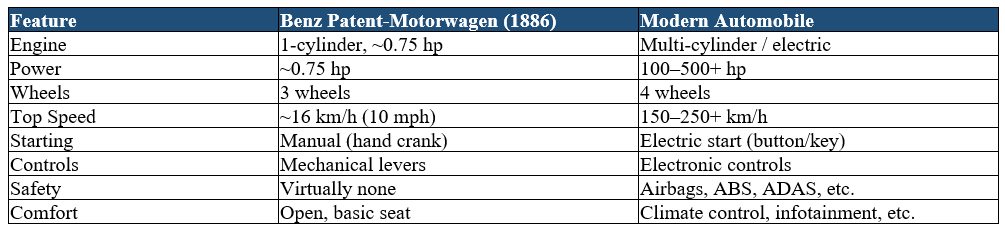
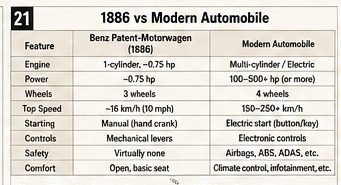
To put more than a century of progress into perspective, here's a side-by-side comparison of the original vehicle against a typical modern car.
Why This Early Automobile Still Matters
The truly revolutionary part of the invention wasn't any single component; it was the integration of multiple technologies into one functioning road-going machine. Benz combined an internal-combustion engine, fuel system, ignition, cooling, mechanical transmission, steering, braking, chassis, and wheels into a single vehicle, and that integration is exactly what made it historically significant. In doing so, the Benz Patent-Motorwagen established ideas that would evolve into modern automobile engineering, including gasoline propulsion, dedicated vehicle chassis, mechanical power transmission, steering and braking systems, fuel systems, engine cooling, vehicle controls, and lightweight construction — nearly all of which underwent enormous development over the following decades.
Final Thoughts: What to Remember About the World's First Automobile
If you remember only a handful of facts about the Benz Patent-Motorwagen, remember these: Karl Benz built it, it was patented in 1886, it used a gasoline-powered internal-combustion engine, it rolled on three wheels rather than four, and Bertha Benz's 1888 long-distance journey helped prove that the automobile could serve as practical transportation. It's also worth noting that this vehicle wasn't the first self-propelled machine ever built — steam-powered and other experimental vehicles came earlier — but it is generally regarded as the first practical gasoline-powered automobile and a foundational ancestor of the modern car. That's exactly why 1886 remains such a significant date in automotive history: before Benz, the central question was whether humans could build a machine that moved itself, and after Benz, the question became how to make automobiles faster, safer, cheaper, more comfortable, and more useful — a question the industry has been answering for nearly 140 years since.